


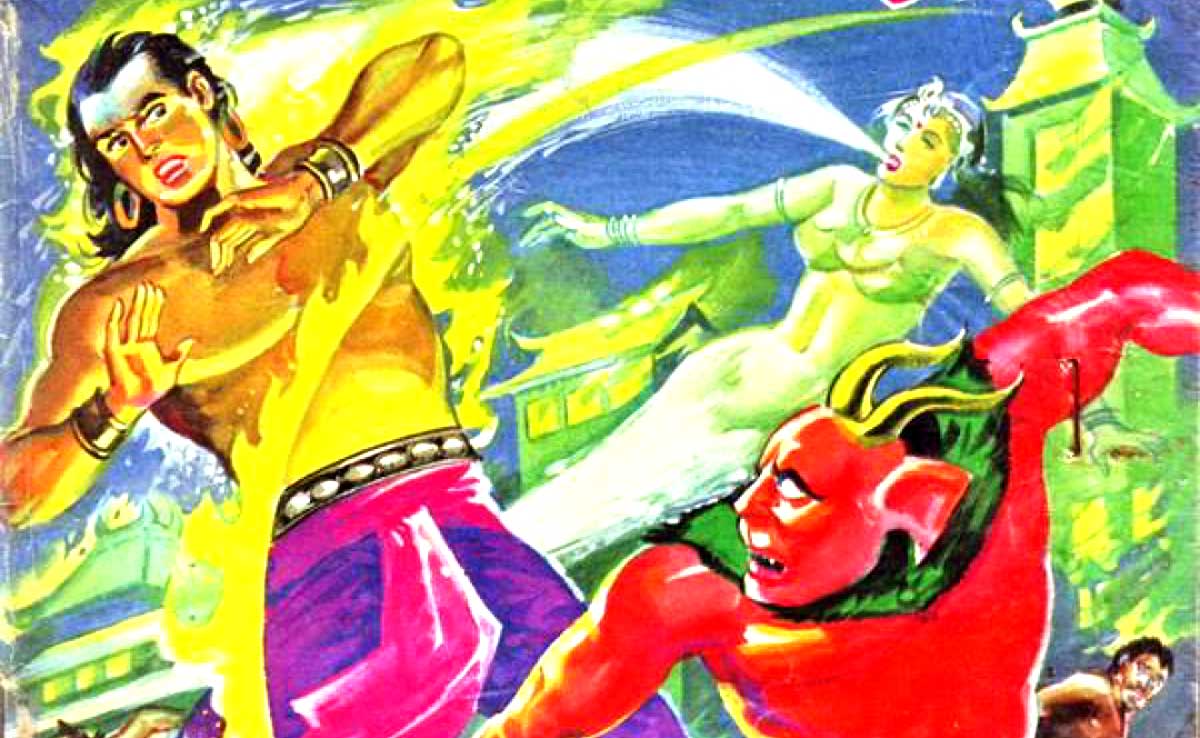
What if such a sacred fire is stolen, without which the entire empire would be on the verge of extinction? Can there be a demon burning in the fire of revenge who uses that divine fire torch for his own selfish purposes and sets out to destroy the entire demonic civilization? When the four main elements of nature—fire, water, air and earth—collide with each other, how far can destruction go?
This memorable comic from the golden era of ‘Raj Comics’, ‘Gojo Aur Vajra’, raises these questions before the readers. This work of writer ‘Raja’ and artist ‘Chandu Studio’ is not just a simple superhero/fantasy story, but it shows the balance between natural forces and the dangerous consequences of their misuse in a very dramatic manner.
Theft of the ‘Agni Mashal’ and the great battle of the 4 elements: what is the main story of ‘Gojo and Vajra’?
The story begins in Agnilok, where the life and breath of its citizens are connected to the flame of the ‘Agni Mashal’. In this world, it is believed that the heat of fire is proof of their survival. But one morning, a mountain of troubles falls on Agnilok—the fire temple guards are found dead and the sacred ‘fire torch’ disappears. The rulers of Agnilok, ‘Agnikumar/Agniraj’ and ‘Agniguru’, get worried because without the torch, the entire Agnilok is soon going to turn into a crematorium.

On the other hand, in Rakshaslok (Dry), a fierce battle breaks out between two powerful demons, Jhinda and Bhanja, over some prey. This war has not even ended when a raging river of fire wreaks havoc on the dry land. This destruction is caused by none other than the Mahachandal Vajra. He has stolen the sacred fire torch of Agnilok and has raised an entire army of fire soldiers to destroy all traces of his enemies (the residents of Bhukuti and Sukhara).
Meanwhile, a different incident is taking place in a corner of the earth (Takshashila). Yam (the sand demon), a resident of ‘Retisthan’, wants to absorb the water princes Neelabh and Shwetam and dry them up so that he can solve the water problem of Retisthan. This is where Gojo, the main hero of this story, enters. Gojo frees Neelabh and Shwetam from the clutches of Yam with the help of his amazing powers, Shakal (flying bird), Bijlika (lightning goddess) and his sharp intelligence. After this, the water powers (Neelabh and Shwetam) join Gojo out of gratitude.

When Gojo learns that Mahachandal Vajra is destroying both Sukhara and Agnilok by misusing the fire torch, he goes to war to stop this major crisis. The last part of the story is based on the great battle of the elements, where Gojo defeats Vajra’s ego and his fire power with the combined powers of his intelligence and hydroelectricity.
Gojo, Vajra and Yam: memorable characters depicting 4 powerful elements of nature
The biggest feature of this comic is its different and balanced characters:
• Gojo (hero): Gojo is a unique hero from the early era of Raj Comics. He does not have any conventional weapons; rather, he depends on the divine powers emanating from his soul/body—such as Shakal (power in the form of an eagle) and Bijlika (power in the form of lightning). He is not only powerful but also uses scientific and natural logic (such as the theory of converting water into ice or steam) in difficult situations.
• Neelabh and Shwetam (water element): Both of these characters represent the form of water. Neelabh’s body can turn into streams of water, while Shwetam’s fingers emit deadly showers of water. The story also shows that when they become too emotional or angry, these powers can become a problem for the hero himself.
• Yam (earth/sand element): Yam is an antihero who becomes a villain because of his selfish desire to obtain water for his people. His body is made of sand particles, which cannot be cut with swords.
• Mahachandal Vajra (main villain): Vajra symbolizes a completely destructive mindset that seeks only to wreak havoc by gaining the greatest power (the fire torch).
Chandu Studio’s Magic: Know Why This Amazing Comic Artwork of the 90s Is Special
The artwork done by ‘Chandu Studio’ is the biggest strength of this comic. The hallmarks of comic art of the 80s and 90s were vivid colors, dramatic visuals and angry facial expressions—they all appear in this issue in spectacular form.

• Portrayal of Fire: The intricately combined red, yellow and orange colors that depict flames, rivers of fire and monstrous faces formed by flames on the pages amaze the reader.
• Visual effects of water and electricity: The scattering of Neelabh’s water body and the visuals of Gojo calling Bijlika make striking use of blue and white colors.
• Action sequence: The transition of scenes from panel to panel is very smooth and fast. Especially the scene of a river of fire entering the demon settlement on pages 7 and 8 and the action scene in which Vajra is plunged into the ground on pages 29-30 are fine examples of comic art.
Fast-Paced Storytelling and Classic Hindi: Know the power of the screenplay of this fantasy comic
Author ‘Raja’ has given a very fast pace to the story. The story doesn’t feel like it stops anywhere. The 32-page comic combines events from three different worlds (Agnilok, Sukhara/Rakshaslok, Retisthan/Earth) in a very fine way.

Talking about the dialogues, Raj Comics’ traditional ‘classic Hindi’ (a unique blend of simple and difficult Hindi words) has been used. The use of words and phrases like “fire-heat is the proof of being alive”, “destructive power”, “Kinkartavyavimudh”, and “Niti-Viruddha” creates a grand and mythological/fantasy atmosphere in the story.
End of ego and natural balance: This deep message comes from ‘Gojo and Vajra’
This comic is not limited to entertainment, but it also gives a deep message:

1. Misuse of power causes downfall: Vajra had immense power through the fire torch, but he used it for destruction and arrogance, which ultimately led to his destruction in the same fire.
2. Law of Natural Balance: Water, fire, air and soil are useful only as long as they are in balance. If fire increases too much, it can burn everything; but the proper use of water and electricity can conquer it.
3. Forgiveness and Wisdom: Gojo not only defeats his enemies, but when Ratim and Yam admit their mistakes, he forgives them and arranges water for their people.
Should you re-read this classic work of Raj Comics?
‘Gojo Aur Vajra’ is one of those brilliant comics from the early era of Raj Comics that took fantasy and action to new heights in the world of Indian comics. Its strong story, vibrant artwork and unforgettable villain (Vajra) make it worth reading again and again.

