


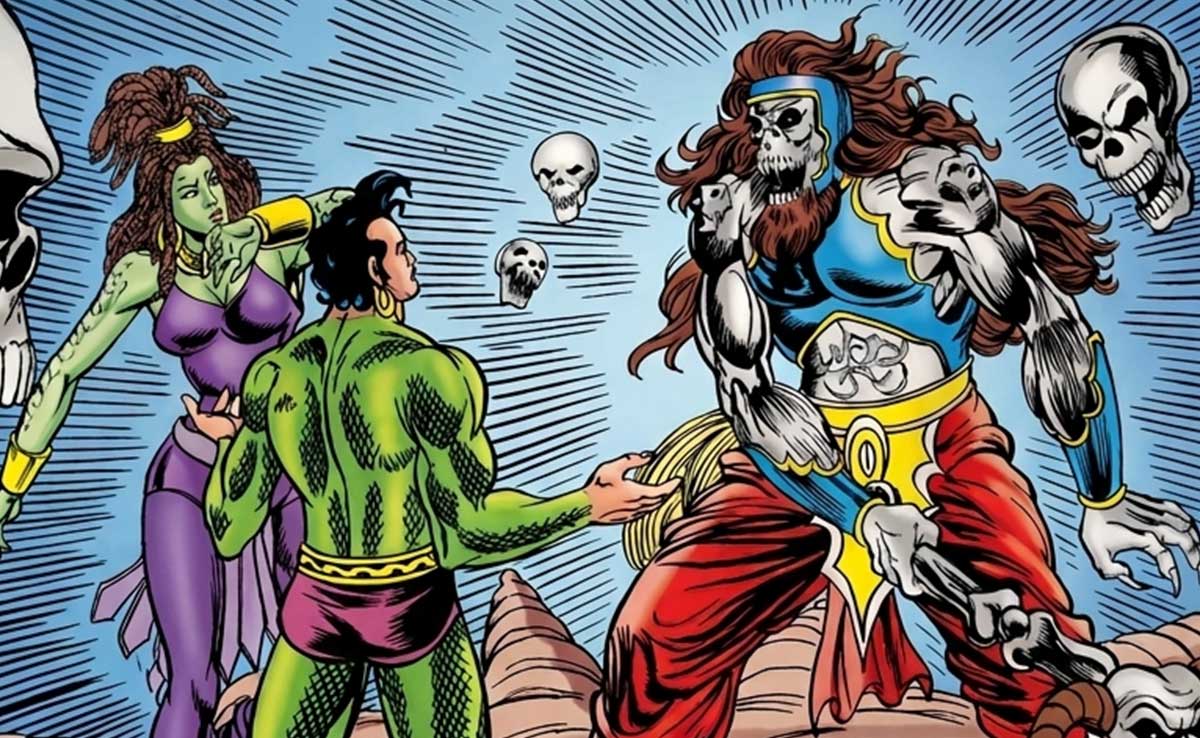
In the exciting world of Raj Comics, the journey from ‘Mrityudand’ to ‘Mahayuddha’ is not just a superhero story, but one of the biggest and most important sagas in the history of Indian comics. Here, Nagraj’s battle goes far beyond ordinary criminals to confront the immense powers of time, science, the system and the entire universe itself.
The true strength of this saga lies in its different types of villains and their immense powers. Here, the hero faces not only physical strength, but also the misuse of science, tantric tricks, betrayal by his own people and the unchangeable rules of time and death themselves. Nagpasha, troubled by the curse of immortality; the arrogant Gurudev, who destructively misuses science; Nagina, the mistress of Tantra and Vashikaran; and Mashrella, born from the radiation of the future, all come together to form such a maze where Nagraj’s existence and his understanding of right and wrong are challenged at every step. His understanding and willpower are severely tested. When all three periods of time (past, present and future) are at stake, personal revenge takes the form of a great war involving the entire universe. This article deeply analyzes all the dangerous enemies, conspiracies and spiritual obstacles of this Mahagatha, which together bring Nagraj face-to-face with the toughest war of his life.
Nagpasha: Jealousy of immortality and the madness of becoming the Trikal Emperor
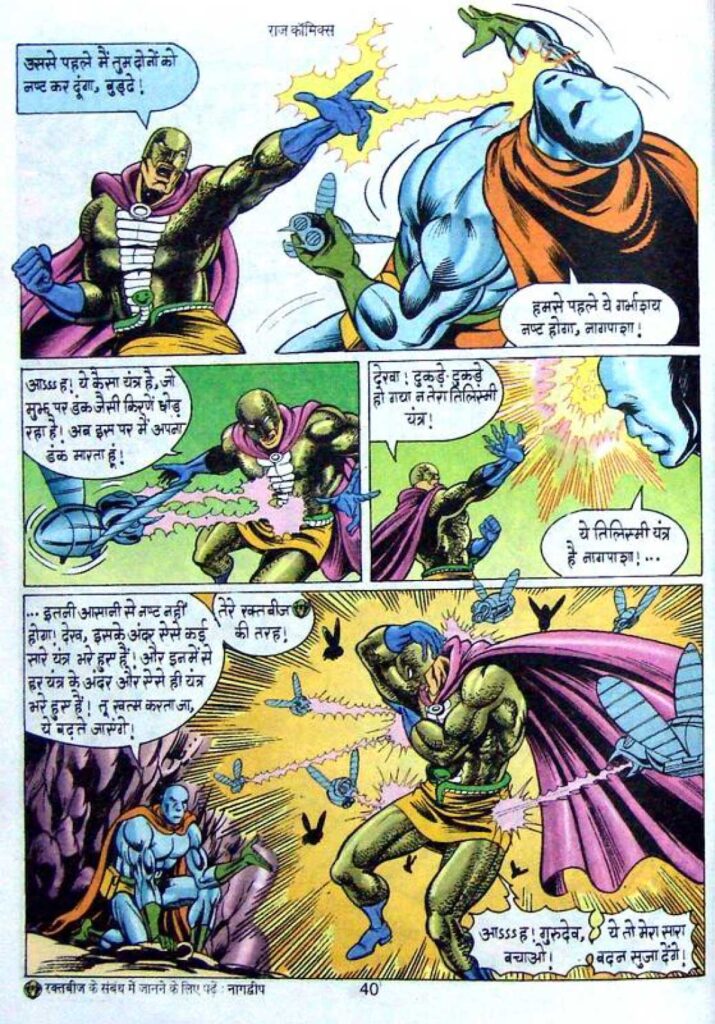
Nagpasha is at the center of this entire devastation. At the beginning of ‘Mrityudand’, he is so devastated by his continuous defeats that he wants to die, but the blessing of immortality has become hell for him. He repeatedly bites his neck and jumps into the fire, but death does not accept him.
When his master tells him about Kaljayi’s secret treasure, which contains the three gems of time (past, present and future), his despair turns into a terrible obsession. He understands that by acquiring these gems, he can kill Nagraj and rule the entire universe across time.
Throughout this saga, he behaves like a timid but extremely cunning hunter. Instead of coming forward himself, he renders Nagraj helpless with the help of Gurudev’s instruments and Nagina’s tantra. By the end of ‘Mahayuddha’, he acquires the powers of Trifana and appears truly invincible for a moment. His character shows the extent of jealousy, where a person does not hesitate even to shed the blood of his loved ones.
Gurudev: Father of destructive science and cruel conspiracies
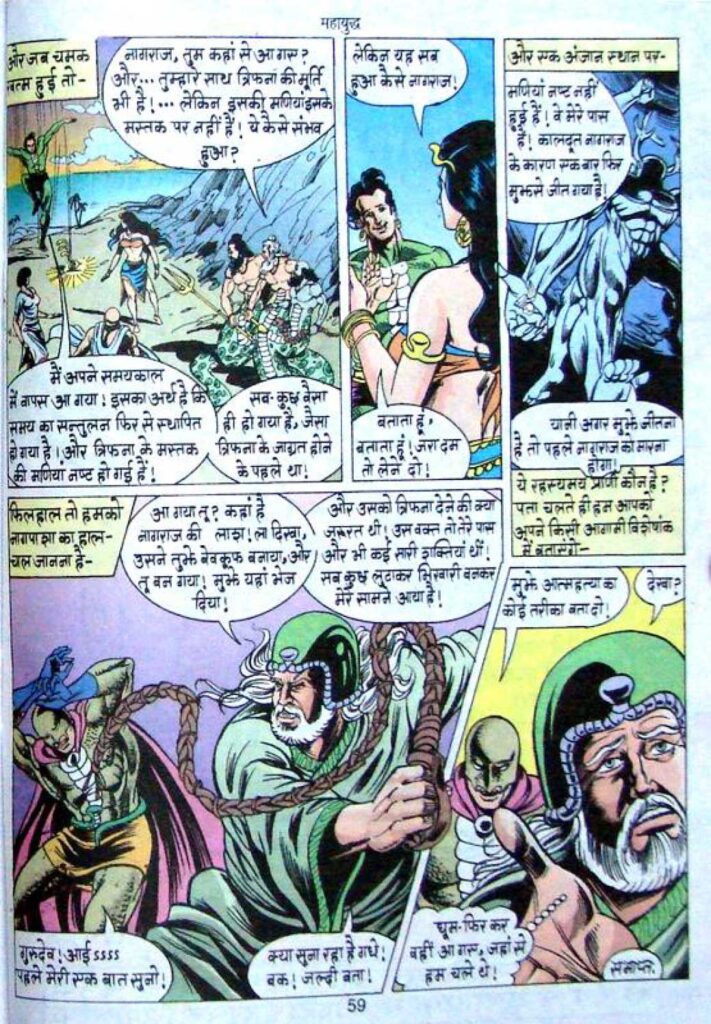
Gurudev is not just Nagpasha’s guru, but the real ‘mastermind’ of this entire saga. He uses technology and dark powers together. He created demons like ‘Makshma Yantras’ and ‘Rakshankhor’ to defeat Nagraj’s Ichchhadhari powers.
Gurudev’s most brutal conspiracy was to prepare an ‘artificial womb’ using Nagraj’s skin and King Maniraj’s ashes. He wanted to produce a child who would possess the powers of both Nagraj and the royal lineage. By enslaving him, he wanted to capture Nagdweep. He tortured Bharati and Vedacharya by imprisoning them in his laboratory so that he could mentally break Nagraj.
Gurudev’s pride compels him to compete with the gods. He firmly believes that his powerful machines are greater than any divine power. Sitting behind the curtain, he throws Nagraj from one period of time to another with ‘remote-transmission instruments’. This is what makes him the most intelligent and murderous enemy of Nagraj’s life.
Nagina: Mistress of deception and Tantric Vashikaran
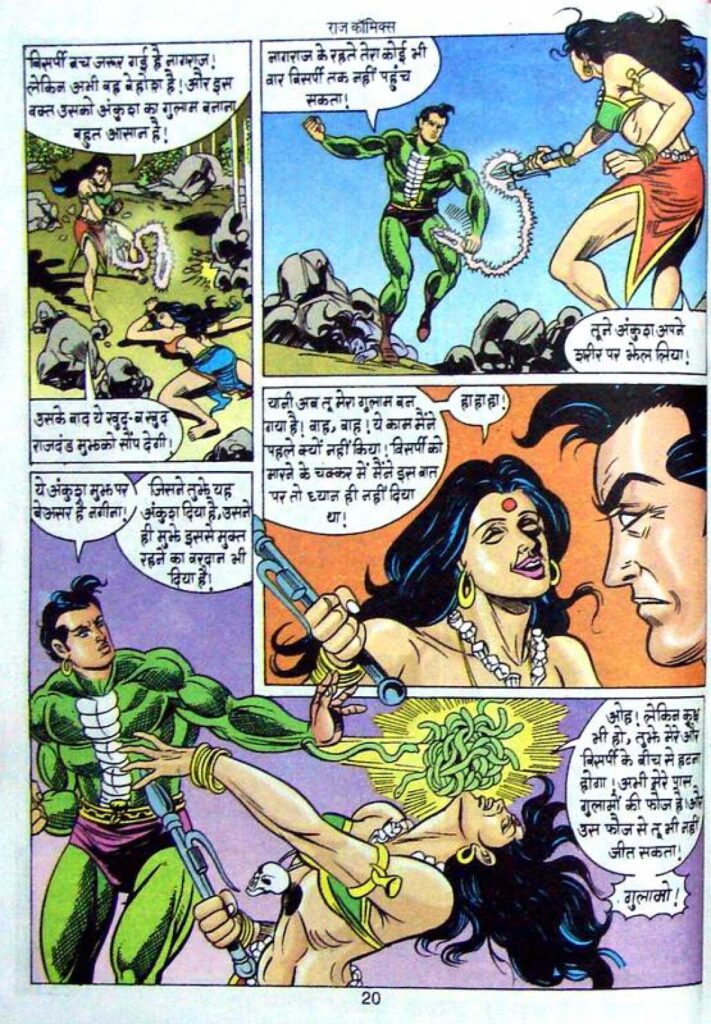
Nagina is the poisonous beauty of Naglok for whom relationships and loyalty are only means of fulfilling her own motives. She conspires with Nagpasha, but she also has a separate plan of her own. Her greatest strength is her ‘tantric control’, which can destroy the willpower of any living being.
With the power of this control, Nagina made a very powerful saint like Mahatma Kaldoot her slave. She forced him to fight against his own disciple, Nagraj. She also turned the loyal warriors of Nagdweep—Singhnag, Nagarjuna and Nagapreti—into her puppets.
During ‘Trifana’ and ‘Mahayuddha’, she constantly plays with Nagraj’s emotions and repeatedly uses deception to seize the gems. Her character proves that deception and subjugation can inflict wounds deeper than swords. She does not give up until the end and takes Nagraj to the brink of death with her Tantric knowledge.
Mashrella: Invincible terror born from future radiation
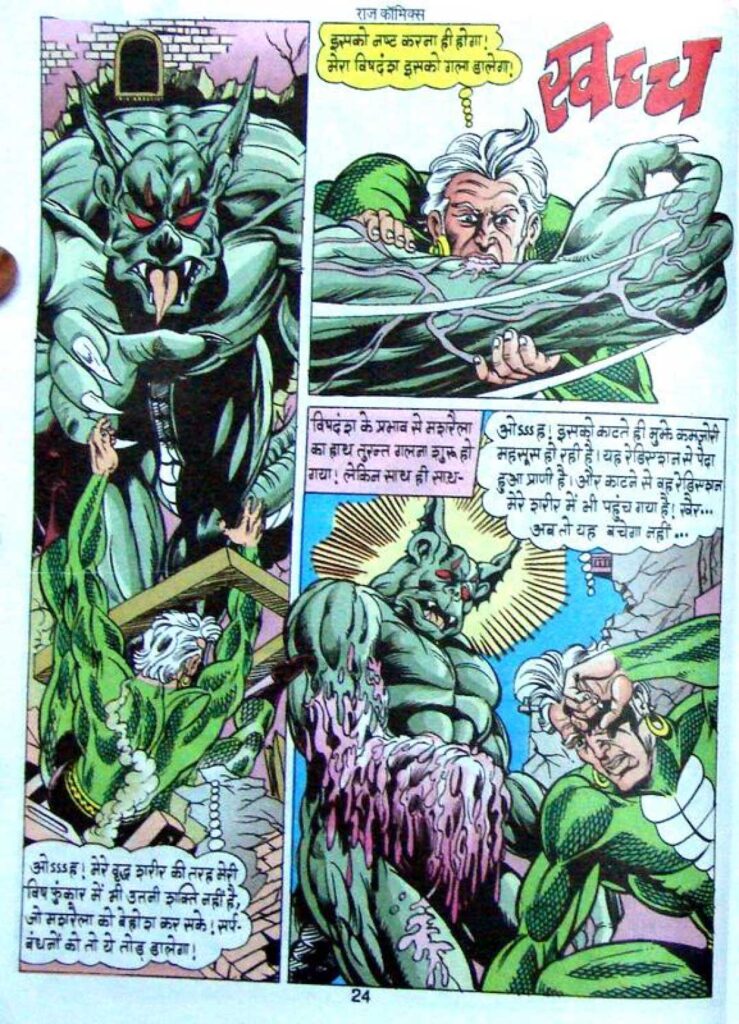
In ‘Mahayuddha’, Nagraj, who has reached the future, faces Mashrella. Born from nuclear wars and their deadly radiation, Mashrella is a huge and invincible monster who rules among the ruins of devastated metropolises. The people there sacrifice an innocent person every day to save their lives.
Mashrella’s skin is so strong that even futuristic laser guns and beam weapons cannot scratch it. When the old and weak Nagraj clashes with him, Mashrella picks him up like a toy and throws him to the ground. This becomes Nagraj’s final test of physical strength against an enemy.
Nagraj understands that Mashrella cannot be killed from the outside. So, he enters his body in a subtle form and destroys his heart, which beats with nuclear energy. Mashrella serves as a reminder of how a mistake in science can give rise to demons.
Vishandhar: Traitor of Nagdweep, minister and greedy for power
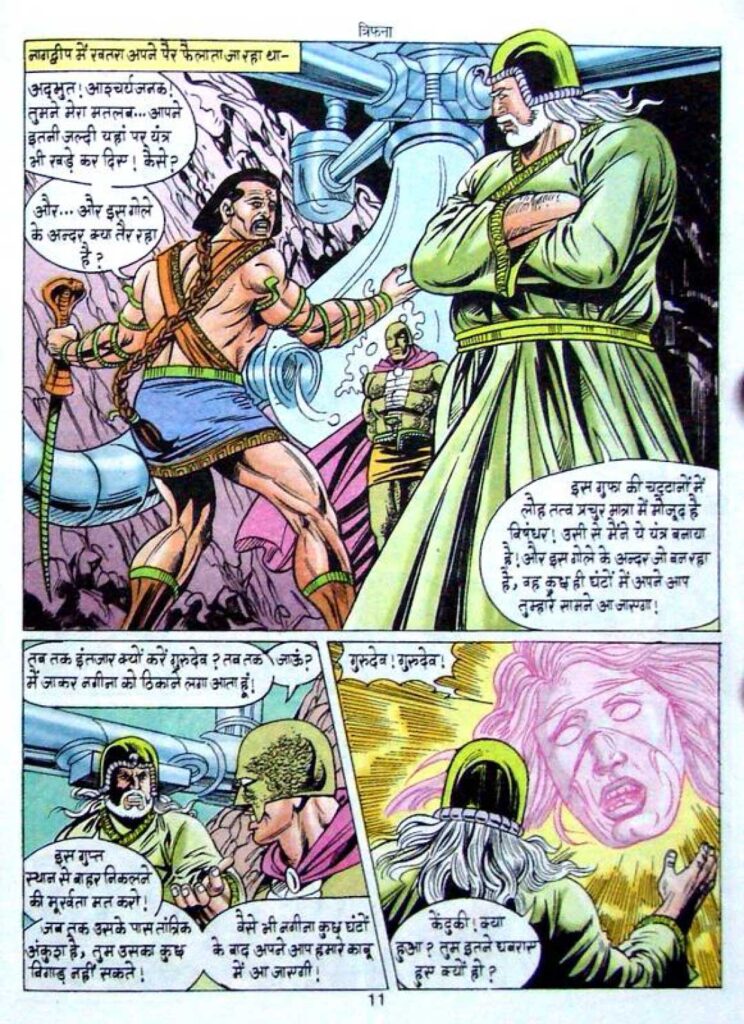
Vishandhar is an important villain in this saga who proves to be an ‘enemy within’. He is a minister of Nagdweep, but he has always desired to seize power. After the death of King Maniraj, he began dreaming of making himself the ruler of the island.
He made a secret agreement with Nagina and Nagpasha and informed them about the secret paths and mantras of Nagdweep. It was because of his betrayal that Nagina was able to enter the palace and break open Mahatma Kaldoot’s tomb. He weakened Nagdweep’s defenses from within so that Nagina’s Vashikaran could enslave everyone.
Instead of fighting from the front, Vishandhar stabs his loved ones in the back through conspiracies. His character shows that when a protector begins causing destruction, it becomes difficult to stop the devastation. His cunning made it extremely difficult for Nagraj to save his motherland.
Kentuki: Gurudev’s intelligent and ruthless scientific assistant
It would be a very big mistake to consider Kentuki merely an ordinary assistant. He is the main architect of Gurudev’s destructive empire. Gurudev makes the plans, but Kentuki carries them out. He easily controls complex machines, remote-transmission devices and biological experiments.
When Gurudev is busy fighting Nagraj, Kentuki manages the laboratory’s tight security and keeps an eye on Bharati. On several occasions, he used subtle instruments that entered Nagraj’s body and blocked his veins.
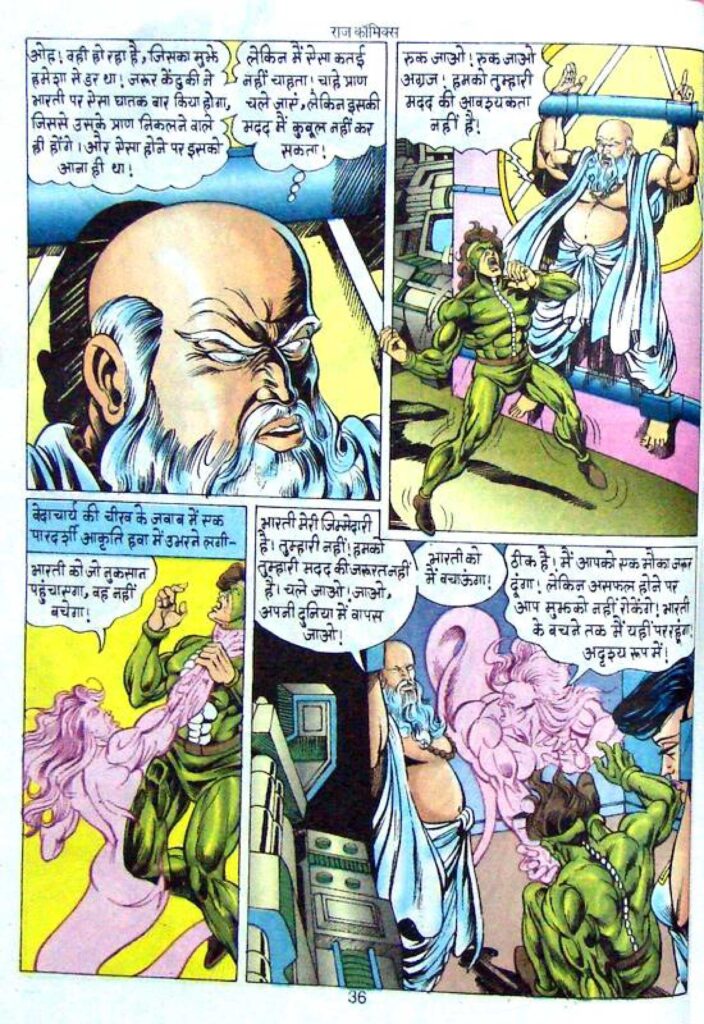
Kentuki is completely loyal to Gurudev and Nagpasha. He does not shy away from sacrificing any innocent person. In ‘Mahayuddha’, when Nagraj tries to return from the future, he attempts to close the doors of time with his instruments. Even without picking up a sword, he can cause the deaths of thousands of people.
Rakshak and Raktabeej: Deadly experiments involving machines and cloning
Gurudev created two demons that defied the laws of nature to eliminate Nagraj. The first was ‘Rakshak’, a Tantra-man whose body had iron coils and injection-like needles. He almost drained Nagraj of his powers by sucking his blood inside the flying plane.
After this came ‘Raktabeej’, who was the most terrible result of Gurudev’s cloning experiments. Every drop of blood that came out of his body would give birth to a powerful warrior as soon as it fell on the ground. Whenever Nagraj struck him, one would become ten and ten would become a hundred.
There was such devastation on the streets of the metropolis that even the police and the army accepted defeat. These two enemies left Nagraj so physically and mentally exhausted that he had to subject himself to high-voltage electric shocks and water tanks to save his life.
Garlgant and Danshak: Tamed Yaksha and rebellious serpent warrior
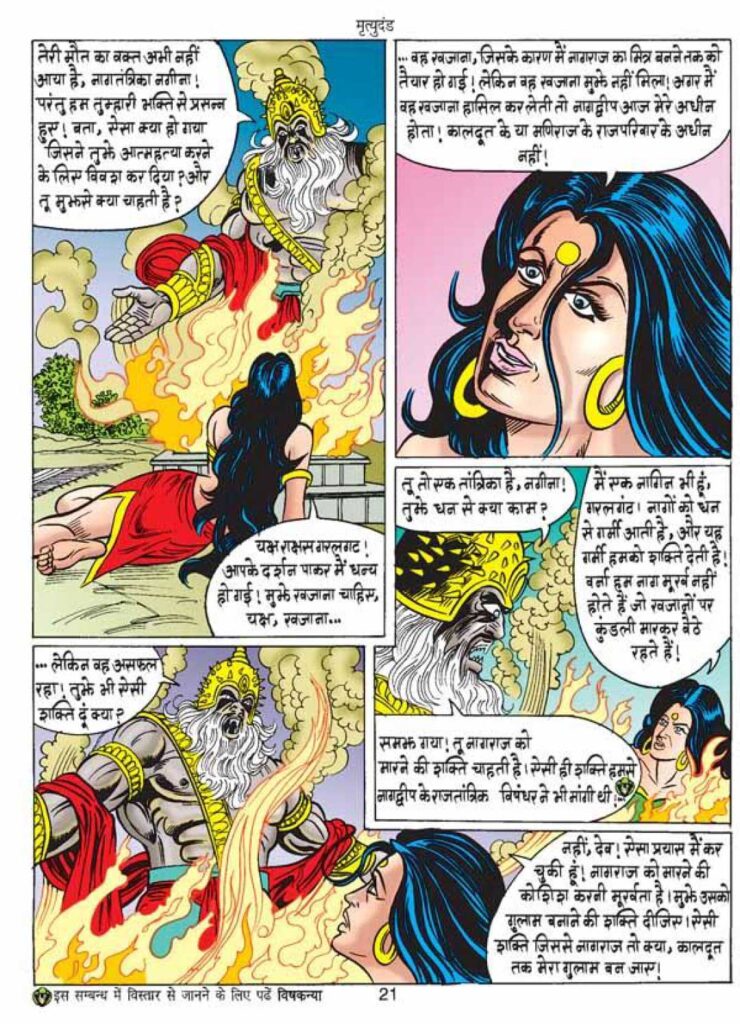
Garlgant is an ancient Yaksha who possesses immense electrical power like the gods. He was not evil himself, but Nagina’s ‘tantric Vashikaran’ turned him into a destructive weapon. He could release energy rays from his eyes that could melt any shield. He trapped Nagraj in such an ‘electric trap’ that even his Ichchhadhari powers could not work.
‘Danshak’, on the other hand, was an ambitious and multi-armed warrior from Nagdweep. He took advantage of the king’s absence to rebel and tried to declare himself the ruler. He launched murderous attacks on Visarpi and went to any extent to seize the scepter.
These two enemies show that Nagraj did not have to fight only external demons. He also had to face powerful beings who, for some reason, had gone down the path of evil. While fighting them, Nagraj had to strike a balance between his bravery and his understanding of right and wrong.
Death and the barriers of time: Spiritual and temporal obstacles
The most mysterious enemy of this saga was ‘Death’ itself, whom Nagraj encounters at the frontier of the future. This was not an ordinary villain, but an unchangeable part of the flow of time. Death had an infinite rope named ‘Mrityupash’, which could separate anyone’s soul from the body.
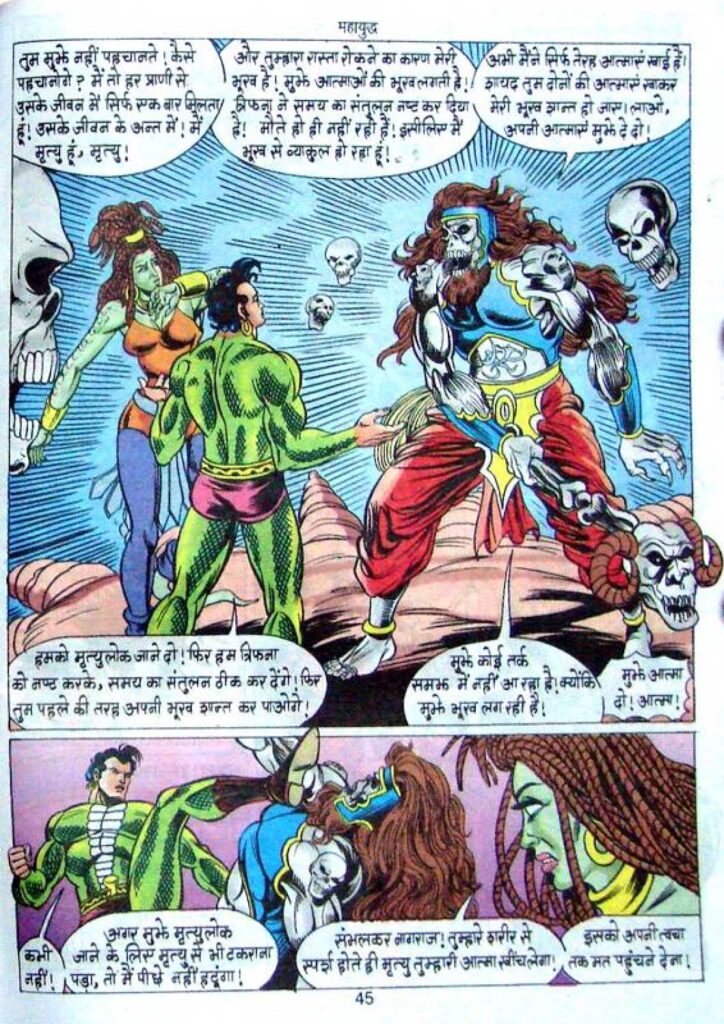
To save the present, Nagraj had to fight Death in person. The fight was not one of punches and kicks, but of willpower. Death reminds him again and again that he is an ordinary person and that, in the end, he must come to him.
Nagraj had to understand that before defeating criminals like Nagpasha, he had to overcome his inner fear of death. Only after overcoming this obstacle did he truly become worthy of being called the ‘great conqueror’.
Completion: The ultimate victory of righteousness over the endless cycle of evil
This saga, from ‘Mrityudand‘ to ‘Mahayuddha‘, is a struggle of sacrifice against greed, wisdom against the misuse of science and loyalty against betrayal. Nagraj defeated Mashrella, shattered Gurudev’s scientific pride and foiled the schemes of Nagina and Nagpasha. In this, the sacrifice and support of Bharati (Visarpi) and Vedacharya were also invaluable.
By protecting all three periods of time and Nagdweep, Nagraj proved that even immense powers cannot stand against justice and strong will. His ‘Mahayuddha’ is the everlasting triumph of good over the endless cycle of evil.
Conclusion
Nagraj’s struggle from ‘Mrityudand’ to ‘Mahayuddha’ shows that real power lies not in immense physical strength, but in the determination not to bow before circumstances. Nagpasha’s jealousy, Gurudev’s arrogant science, Nagina’s poisonous tantra and Mashrella’s destruction together could not extinguish the flame of truth and righteousness burning within Nagraj.
Nagraj proved himself a ‘great conqueror’ by defeating his inner fear of death along with his external enemies throughout this entire long, dangerous and heroic battle for survival. The loyalty of Bharati, Vedacharya and Nagdweep was also part of this victory. This saga proves that power acquired through wrongful means ends in destruction, and the light of truth always prevails over the darkness of unrighteousness.

