


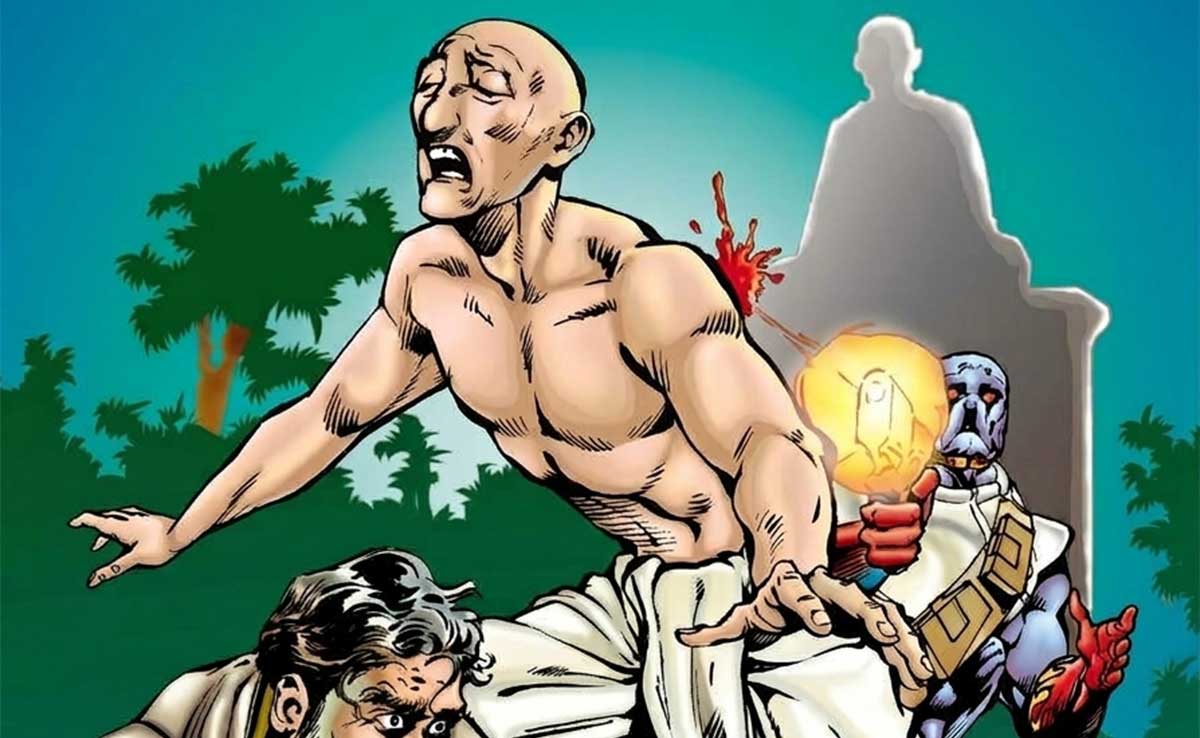
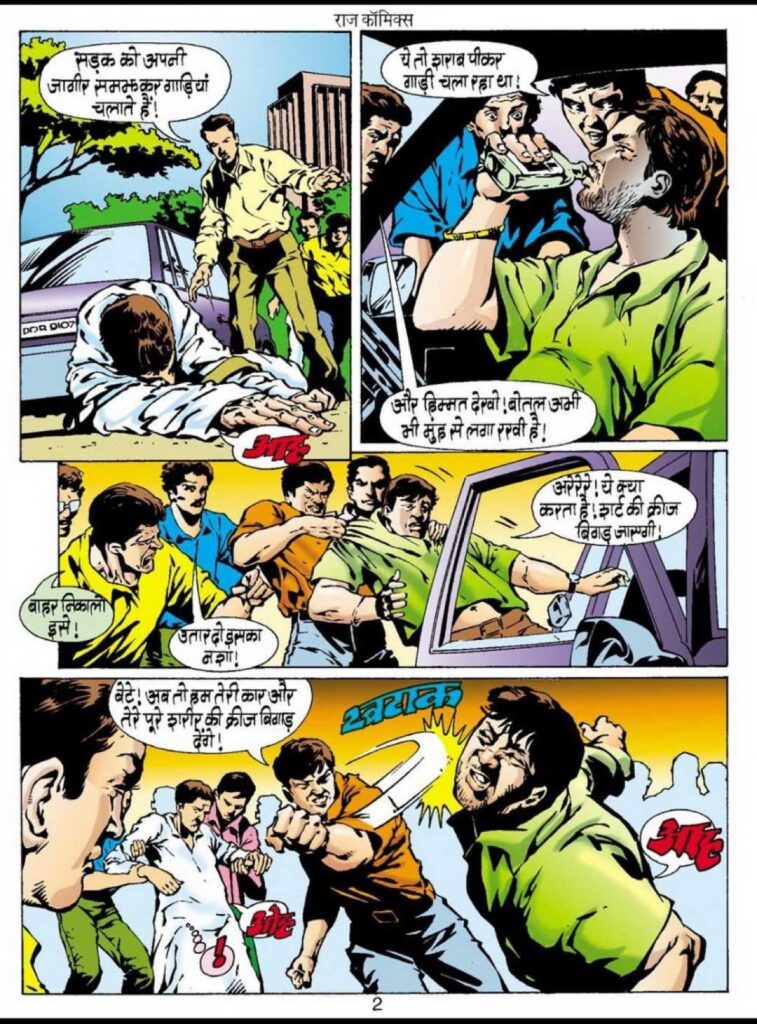
“War only leads to war! Fire does not extinguish fire! Violence does not end violence, but violence still rules the human mind!” This statement, written on page two, presents the main idea of Raj Comics’ Hey Ram (issue number 1055, priced at ten rupees) to readers. Published with the special ‘Doga Year’ logo, the issue does not begin with gunshots like an ordinary superhero comic. It begins with a minor road accident at Nanavati Chowk, which reveals the needless violence and arrogance hidden within a human being.
Writer Tarun Kumar Wahi, story outline writer Vivek Mohan, artist Manu, letterer and colorist Sunil Pandey, and editor Manish Gupta jointly created this comic. It is counted among the most emotional and thought-provoking issues of the Doga series. Cover artist Malti’s cover shows the main conflict of the entire story in a single picture—mafia leader Dada lies bleeding on the ground beneath a statue of Mahatma Gandhi, the Father of the Nation. Doga shoots to kill him, but an elderly Gandhian activist takes the bullet in his chest.
Gandhiji’s Nonviolence and Doga’s Bullets: Who Is Right?
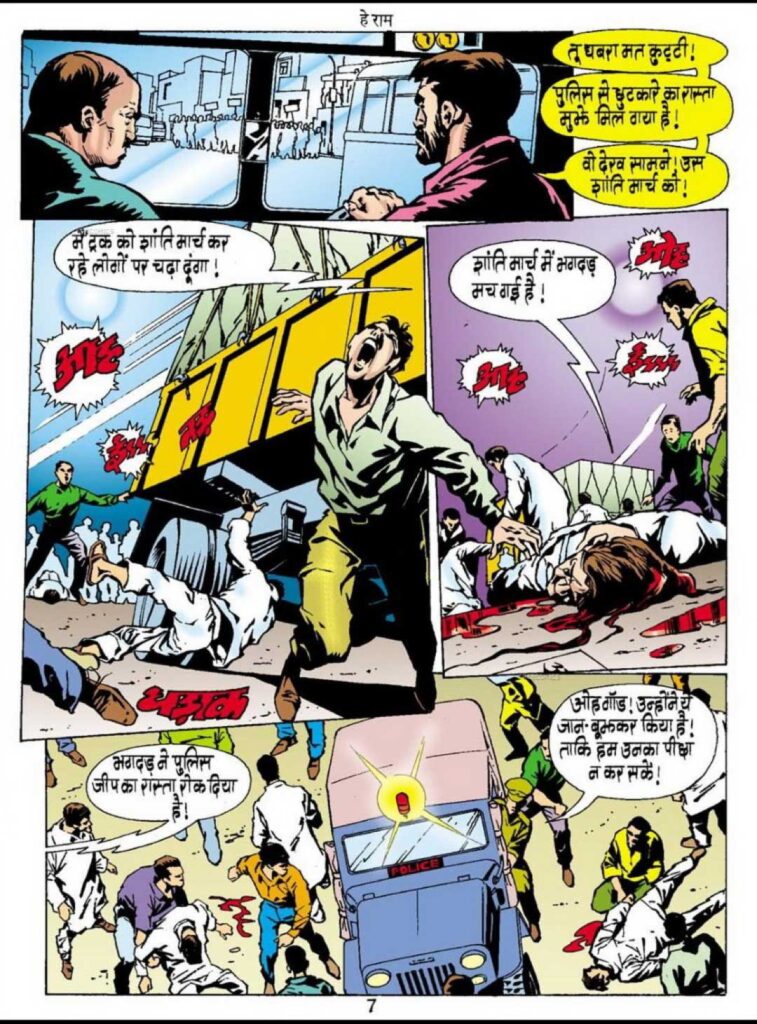
The story of this comic is based on a direct conflict between Mahatma Gandhi’s belief that “nonviolence is the highest duty” and Doga’s use of violence to end crime. The story takes place on October 2, Gandhi Jayanti. On one hand, unarmed people are taking out peace marches in the city, led by Haribabu. People fondly call him Haribapu. On the other hand is the dreaded face of organized crime, Dada, who brutally drives his heavy truck over innocent people in the peace march to escape the police.
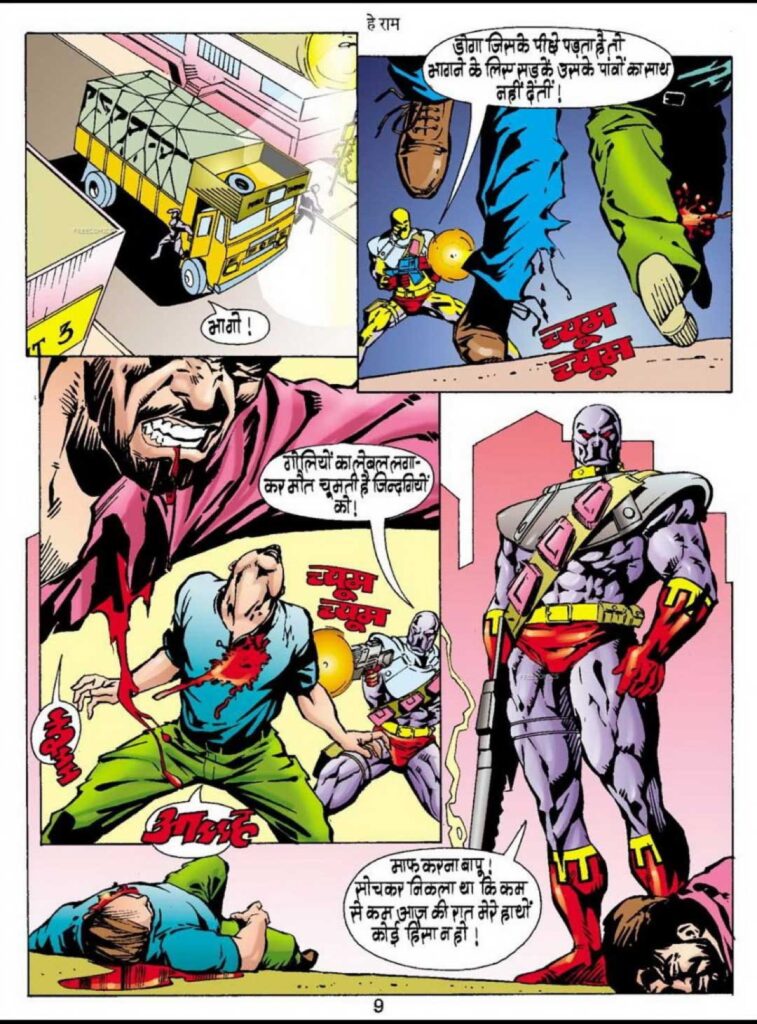
Writer Tarun Kumar Wahi shows the conflict in Doga’s mind in detail here. Doga sets out on Bapu’s birth anniversary promising not to resort to violence, but when he sees the bodies of the innocent people who have been crushed, his gun roars. Doga’s words make his view clear: Gandhiji’s message of nonviolence was only for those who had a heart in their chest and a mind capable of thought. According to Doga, only the language of bullets will work against ruthless brutes like Dada and his gang—“If you cannot let others live, you have no right to live!”
Haribapu and Dada Face to Face at Ahimsa Chowk
The most painful and shocking part of the story comes when Haribabu and his young associates undertake a modern-day ‘Dandi March’ to ‘Dada Tours and Courier Service’, mafia leader Dada’s arms base. Without carrying any weapons and relying only on their courage, they seize many weapons from Dada’s henchmen despite being shot at. They then prepare to burn those weapons in front of Gandhiji’s statue at ‘Ahimsa Chowk’.
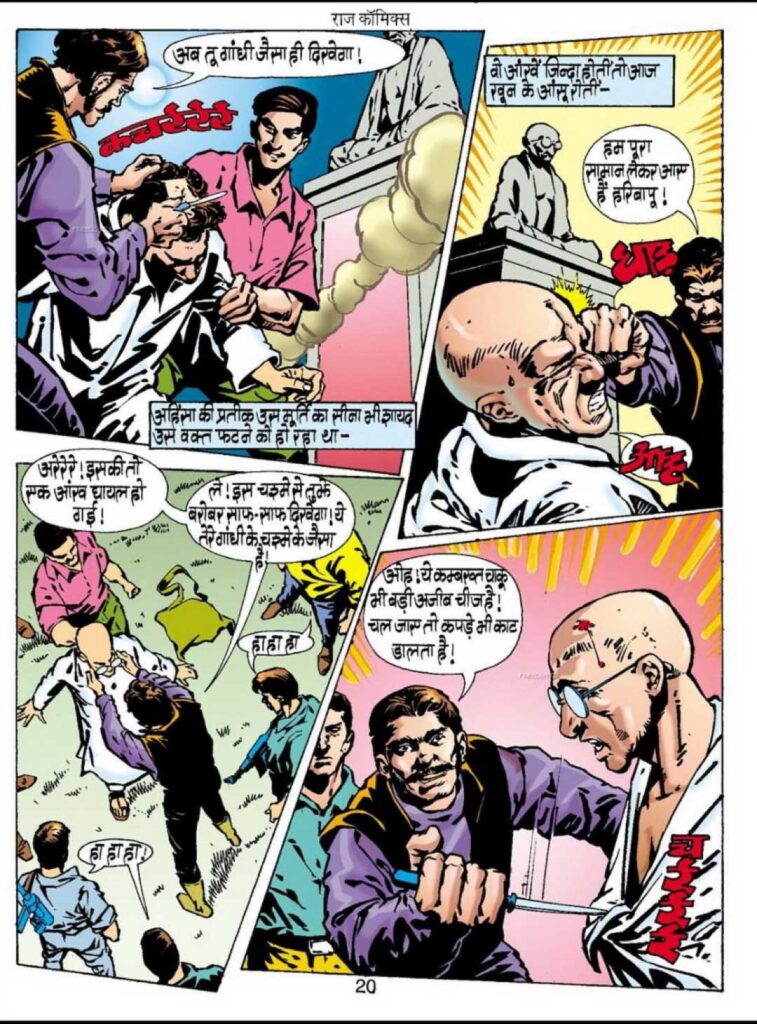
Dada then attacks from a helicopter and tortures Haribabu. This greatly increases the tension in the story. Dada not only injures Haribabu physically but also cruelly insults Gandhiji’s ideals. He cuts Haribabu’s hair and eyebrows, damages one of his eyes, and then forcibly makes him look like a living ‘Gandhi’ by giving him glasses, a dhoti and a walking stick. When Dada tries to break Bapu’s stone statue with a spade, Haribabu places his bloodied body in front of it like a shield. This scene both saddens the reader and fills them with anger.
Doga’s Stick and Haribapu’s Shocking Decision
The story’s last major confrontation also tests Doga’s and Haribabu’s beliefs through intense action. When Dada points a gun at Haribabu’s chest and orders him to say ‘Hey Ram’, Doga arrives. Doga beats Dada not with a gun, but with the same stick Dada gave Haribabu. Doga’s statement that “the silent power of this stick had brought the British to their knees” shows his deep respect for Gandhiji’s strength.
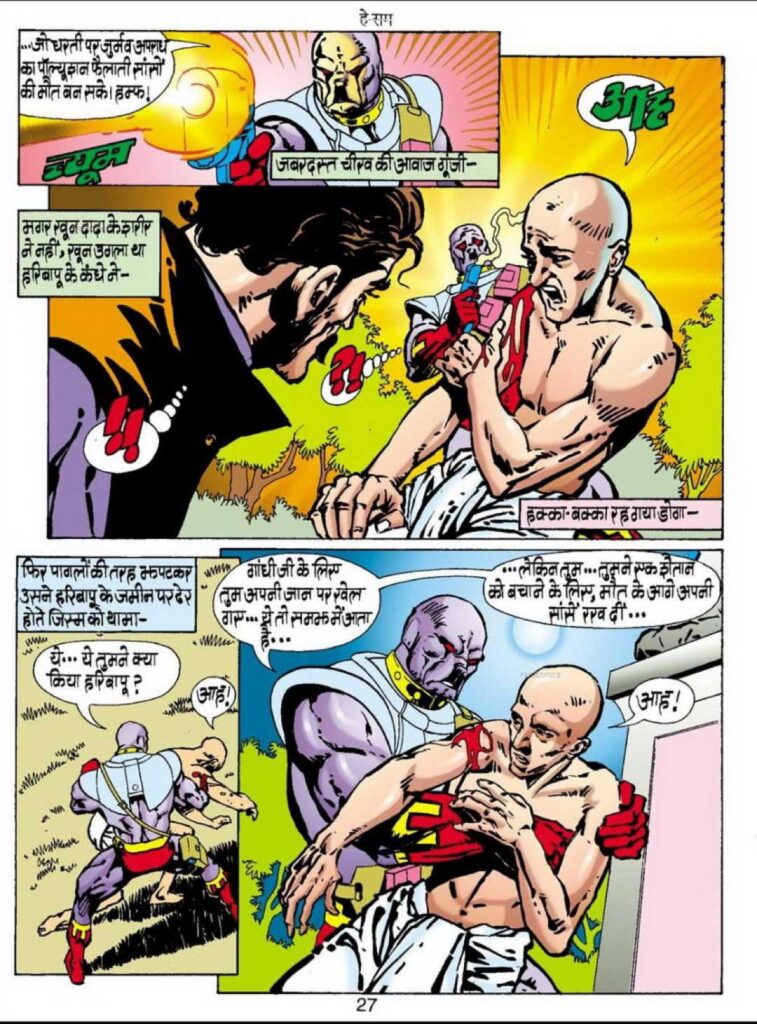
But the story’s most shocking and thought-provoking twist comes in its final pages. When Doga is about to shoot Dada in the head, Haribabu jumps between them and takes the bullet in his shoulder. A shocked Doga asks him why he risked his life to save a devil. Haribabu’s answer becomes the essence of the whole story—“My answer to violence is nonviolence! You responded to Dada’s violence with a bullet, so I had only one answer to that bullet of yours… And after taking your bullet, I gave you that same answer!”
Haribabu, Dada and Doga: How Do Their Beliefs Differ?
This comic centers on three people with different beliefs. The first is Haribabu, who has complete faith in Gandhiji’s principles even today. He believes that anger within humans is the real monster and can only be defeated through forgiveness and nonviolence. This belief makes him a memorable character. He does not merely talk about his beliefs; he proves his faith by taking bullets.
The second character is mafia leader Dada, a completely cruel, power-hungry villain who does not care about the pain of others. His words and behavior highlight the growing power of mafia gangs in today’s society, which regard strength and weapons as the ultimate truth. According to Dada, to live with one’s head held high, one must have violence in one’s mind and a weapon in one’s hand.
The third character is Doga himself, a rebellious protector caught between these two viewpoints. Doga respects Gandhiji’s sacrifice and nonviolence, but the crimes he witnesses make him feel that times have changed. In his view, today’s ‘enemies within’ and bloodthirsty wolves can only be stopped with bullets, not nonviolence.
How Do Manu’s Art and Sunil Pandey’s Colors Tell the Story?
Artist Manu’s illustrations are one of this comic’s greatest strengths. He vividly depicts Mumbai’s streets, crowded intersections, bloodshed and the characters’ expressions. When Haribabu is tortured and made to look like Gandhiji, the helplessness on his face and the pain in his eyes affect the reader deeply. The injuries to his back as he shields Bapu’s statue from the spade are also distressing to see.
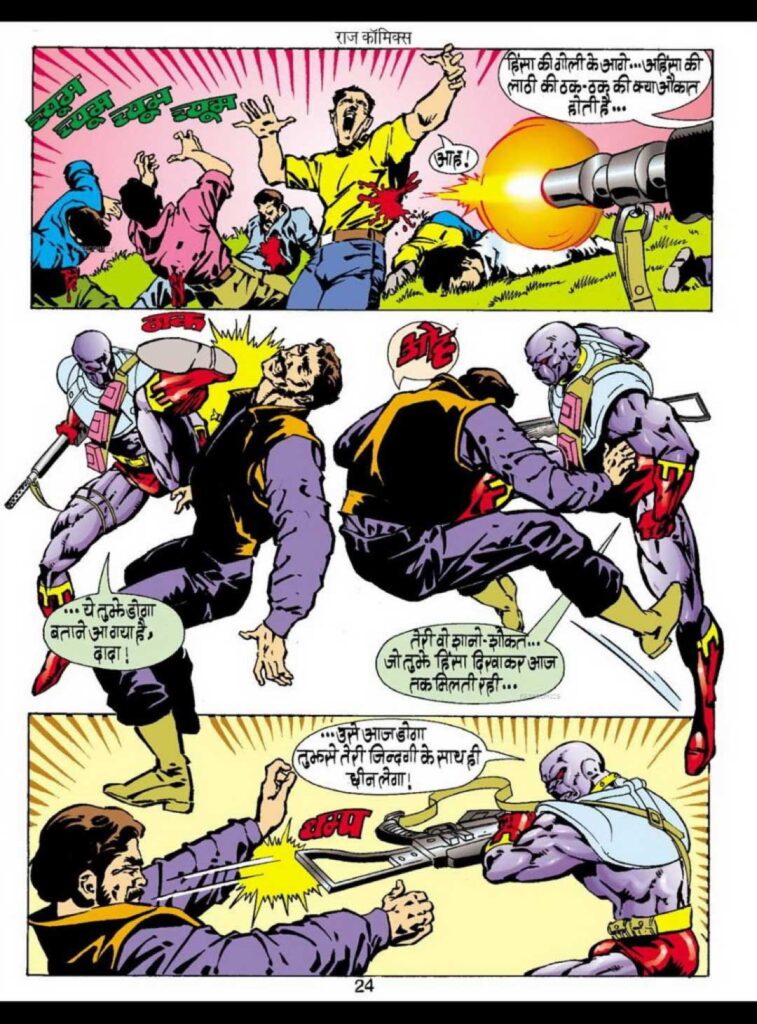
Sunil Pandey’s colors and lettering suit the story’s serious atmosphere. Streams of red blood, the yellow flames of explosions and helicopter smoke against the white clothes worn by the peace marchers strengthen the impact of the scenes. Sound effects such as ‘Gad-Gad-Gad’, ‘Dhayam-Dhayam’, ‘Khachak’ and ‘Khadak’ add intensity to the action.
The Strengths and Weaknesses of ‘Hey Ram’
The comic’s greatest strength is that it speaks openly about violence. It does not show violence merely for entertainment; it asks when violence can be considered justified. The writer succeeds in bringing a superhero known for his extreme violence and guns to a point where he has no answer to the nonviolent courage of an unarmed old man.
As for its weaknesses, Dada’s escape by parachute from a helicopter and his subsequent capture by the police feel somewhat like scenes from a conventional action film. Given the serious question driving the story, Dada’s escape scene could have been tighter. Moreover, the young peace marchers breaking into a base guarded by criminals with machine guns and seizing their weapons seems a little hard to believe and more dramatic than necessary.
What Question Remains for Doga in the End?
The comic ends on page twenty-eight. With a heavy heart, Doga sees Dada in police custody. Below it appears this message—“The fight between violence and nonviolence is not over yet! Wait for Doga’s next comic… Torture.”
Overall, Hey Ram is a unique, courageous and memorable story in Indian comics history. It is not just an exciting superhero story but also a mirror that makes today’s violent society look within itself. Tarun Kumar Wahi’s effective writing and Manu’s vivid illustrations make this issue worth reading for anyone who sees comics as more than children’s stories and values stories that raise serious questions.
