


Alexander’s Era Begins the Mystery of ‘Roman Killer’
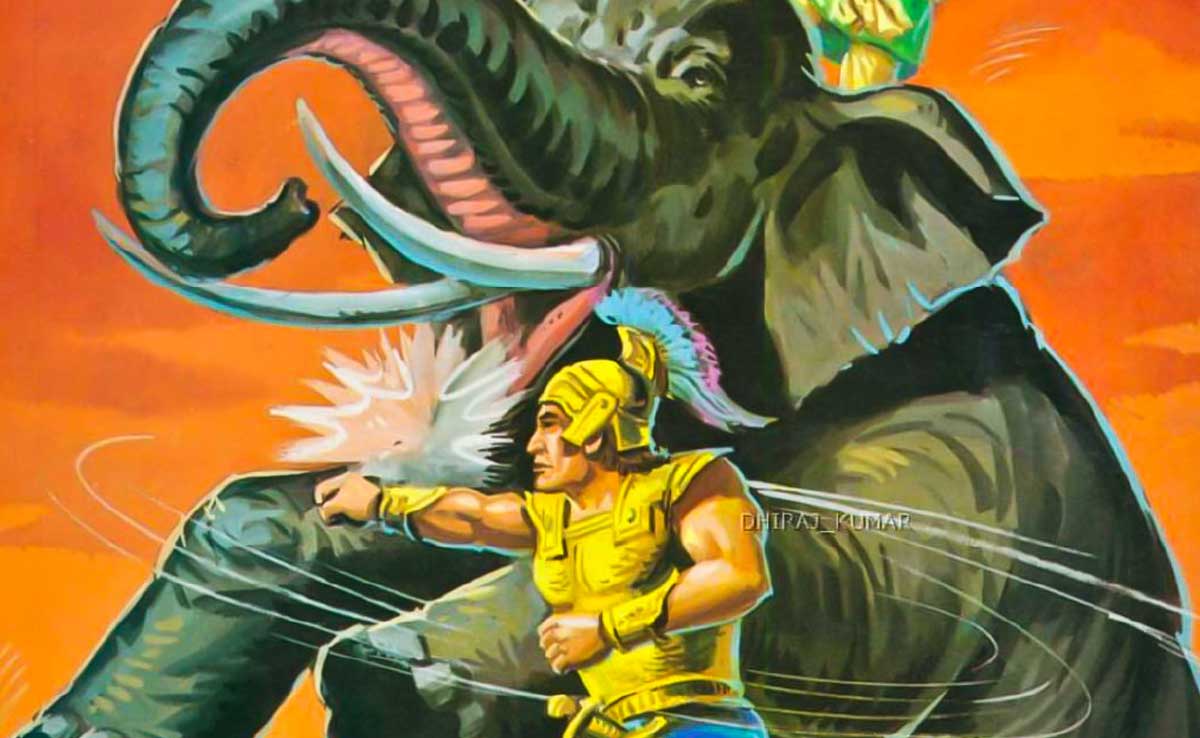
It is 326 BC. A fierce war is raging between the armies of Alexander and Porus on the banks of the River Jhelum. Elephants and Greek soldiers face each other on the battlefield. Linking the story of a modern superhero comic to this historical event is a daring and unusual experiment. Raj Comics issue number 0079, ‘Roman Killer’, makes it clear from the first page that this is not an ordinary urban crime story. Here, ancient history, mysteries surrounding old objects and modern science come together.
This comic by writer and artist Anupam Sinha and editor Manish Chandra Gupta connects an old Roman helmet found among the ruins of the Indus Valley Civilization with present-day greed and power struggles. This creates many layers of mystery in the story. Its historical setting keeps the reader curious to learn what happens next.
The Greed and Struggle for Power Hidden Behind the Roman Helmet
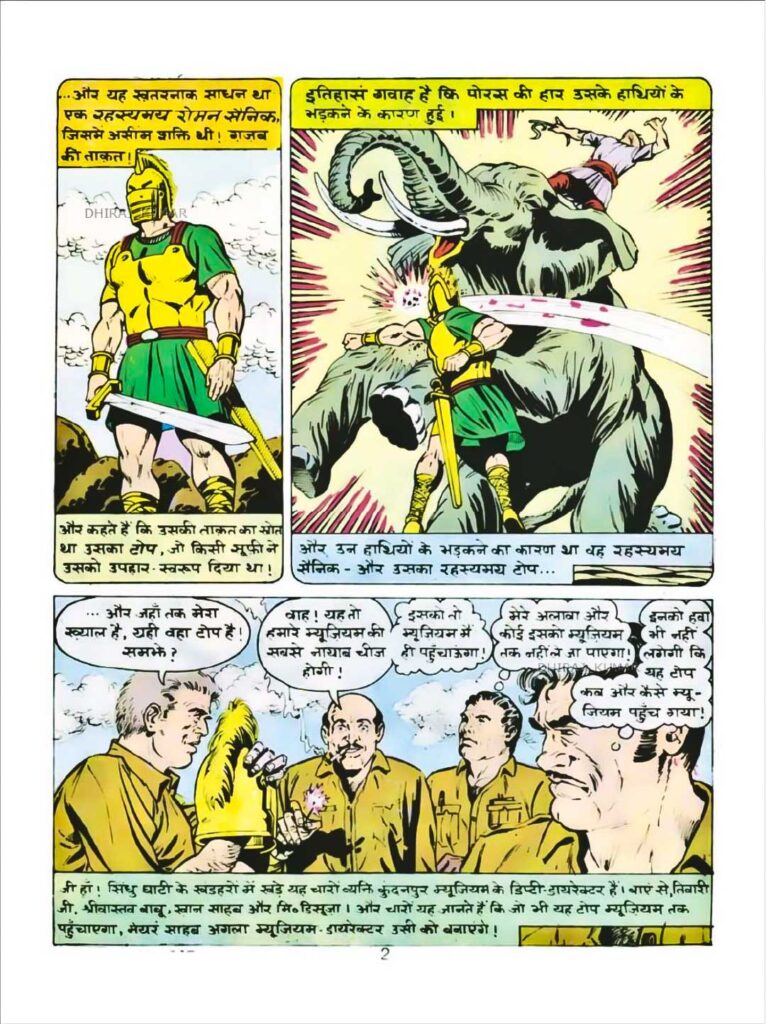
The biggest strength of this comic is the message about social and human behavior hidden within its story. The story is not built around an attack by an outside monster or a fictional alien. Its main theme is the rivalry among four senior officers of the Kundanpur Museum and their greed for promotion. These people belong to the educated and civilized section of society, but their thinking reveals something else.
Instead of preserving a historical artifact, they use it as a means of advancing their careers and securing the director’s chair. This shows how easily a person’s honesty towards their work can break down when an opportunity arises. The game of deception among the four colleagues connects the story to a bitter truth about human nature. Here, villainy does not flourish in some secret place. It is born in the museum’s offices, amid mutual jealousy.
How Does the Mystery of the Roman Killer Last Until the End?
In writing the story, Anupam Sinha has adopted the framework of a classic whodunit thriller. The mystery unfolds very thoughtfully. The writer repeatedly introduces clues that divert the reader’s attention. For this reason, it remains difficult until the end to work out who is actually hiding behind that powerful old helmet.
The story moves at a fast pace. On one side, there is the fear that an old artifact might be stolen and the tremendous physical strength it provides. On the other are major action scenes fought in the air and on the water. Anupam Sinha reveals secrets one by one, and after every new suspicion, another comes to the fore. This does not slow the story down for even a moment. Every incident has a clear connection to the next, which shows how tightly the story is written.
Dhruv’s Intelligence Against a Very Powerful Enemy
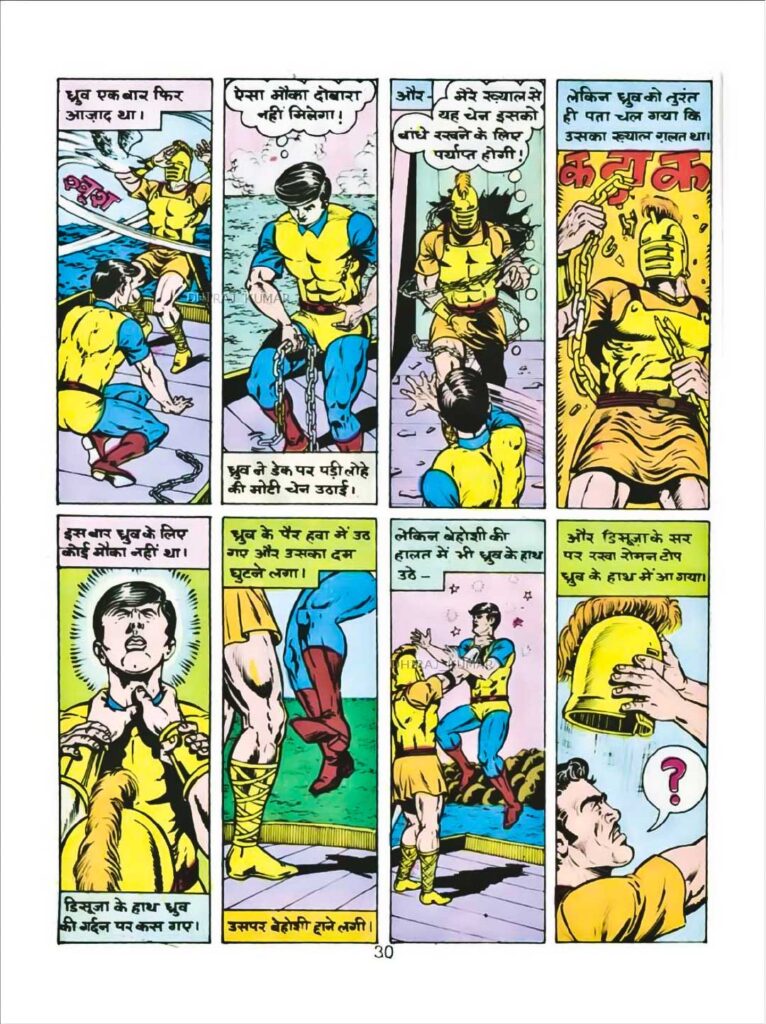
In this comic, the character of Super Commando Dhruv appears in his true form: a hero who uses his intelligence. Dhruv has never been defined by magical powers, and this story clearly shows that. When he encounters an enemy many times stronger than himself, one who is unaffected by bullets and swords, Dhruv understands that physical strength alone cannot defeat him.
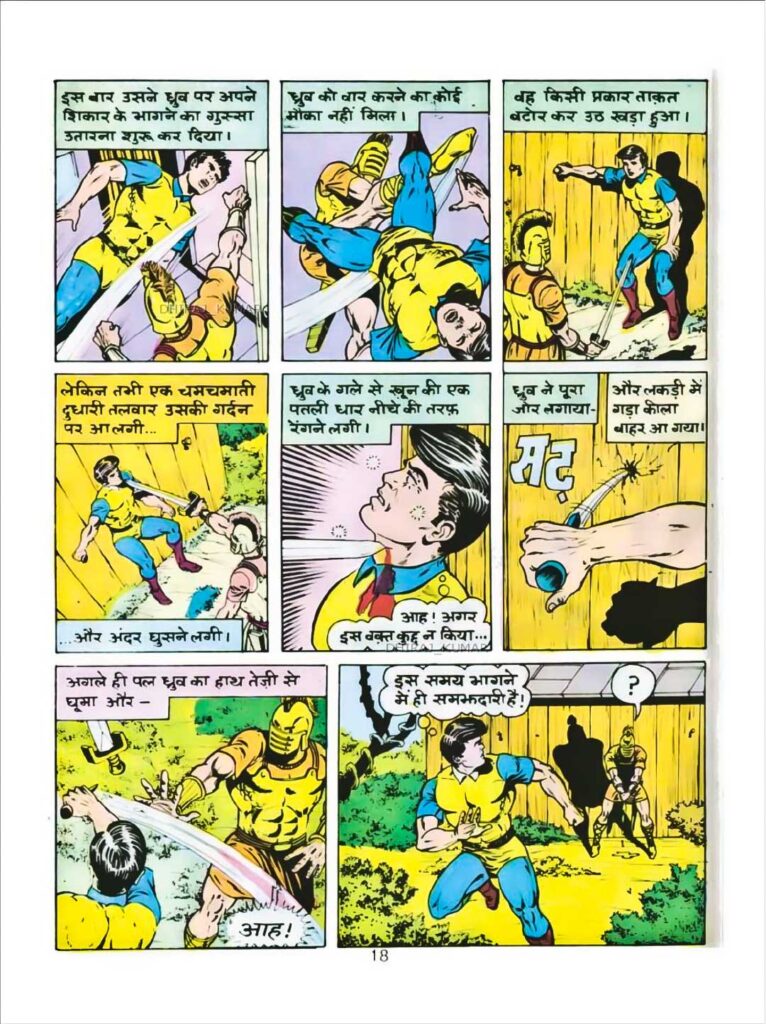
Here, Dhruv plays the role of a superhero as well as a detective. He examines the empty cartridges found at the scene, compares fingerprints and understands people’s tricks. In the end, he does not defeat his enemy with any miraculous force. His victory comes from his intelligence, his ability to make quick decisions and his special skill in understanding the language of birds. This is what makes Dhruv a believable and inspiring hero.
The Power of the Roman Helmet: Magic or Science?
In Indian comics, old mysteries or excavated objects are often directly linked to ‘magic’ or a ‘curse’. One of the great qualities of this comic is that it does not follow that easy path or promote superstition.
When the secret of the mysterious helmet’s immense power is revealed at the end of the story, the writer explains it by linking it to neurochemical effects known in ancient times and the effects of herbs on the body. This explanation tells the reader that there could be an unknown scientific or medical reason behind what people consider magic or a miracle. This kind of thinking in a superhero story gives Anupam Sinha’s writing a distinct identity.
The Beginning of the Commando Force and Dhruv’s Broader Vision
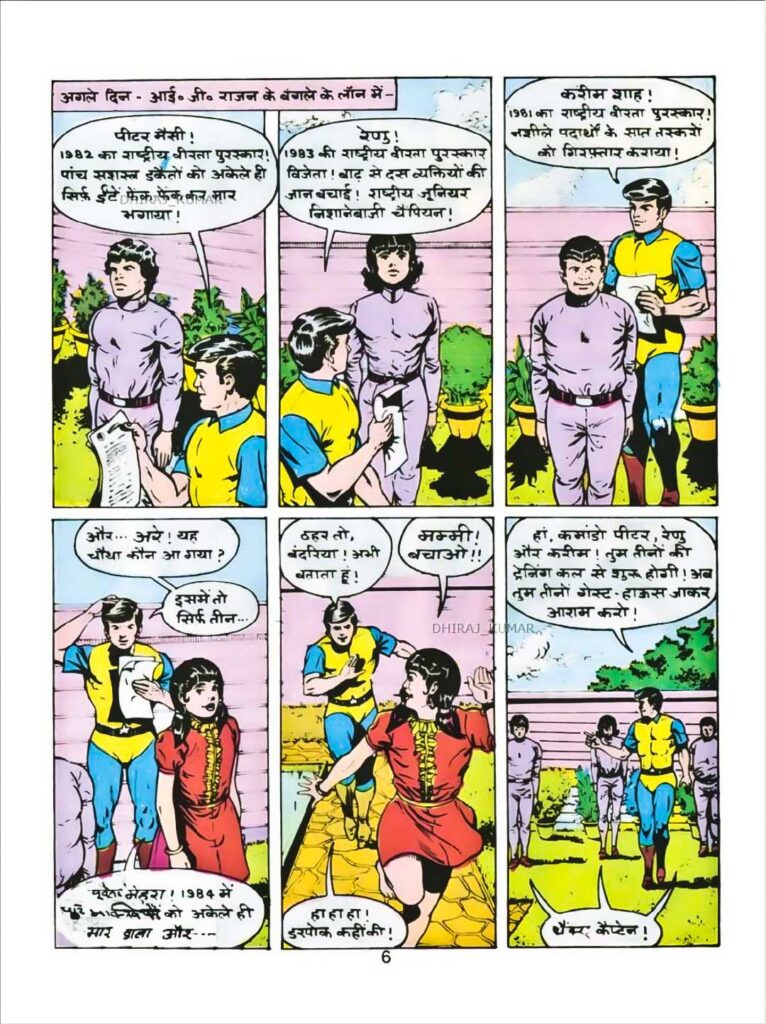
Another special aspect of this issue is Dhruv’s decision to create the ‘Commando Force’. Here, Dhruv does more than show his own bravery. He thinks about creating a system to fight crime that will also be useful in the future.
Choosing children who have received National Bravery Awards, training them and creating a civil defense network in collaboration with the police show how important the participation of ordinary people is in preventing crime. This part, which runs alongside the main story, also shows Dhruv as a hero who guides others and wants to build something for society.
Anupam Sinha’s Artwork and Action Scenes
Anupam Sinha’s artwork is very impressive. Compared with Indian comics of the eighties and nineties, the scenes in this issue look cinematic.
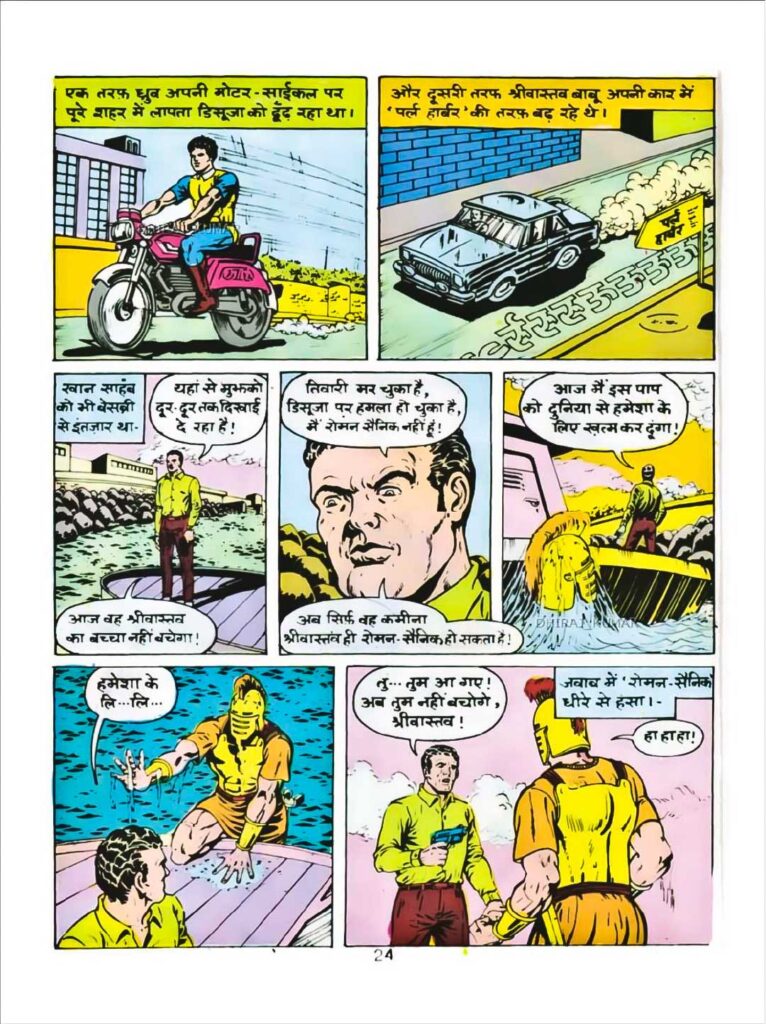
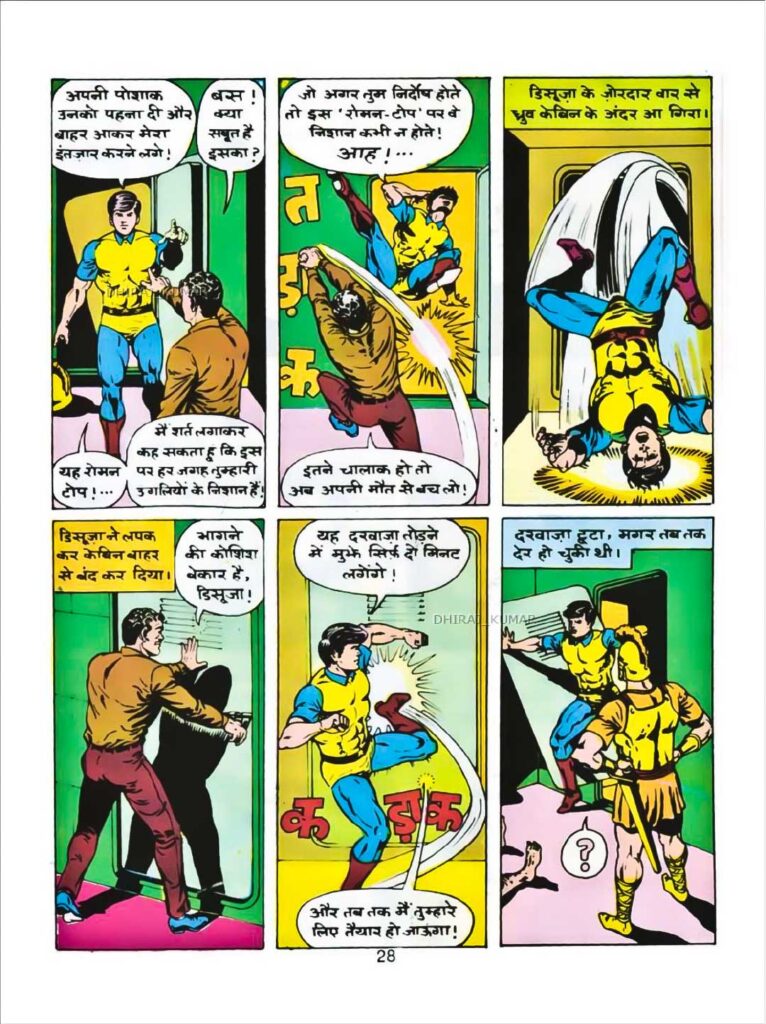
Each panel is designed effectively. Whether it shows an elephant attack on an ancient battlefield, a modern fighter plane attacking from the sky or a close-quarters fight in the cramped cabin of a motorboat, every scene leaves its mark. The faces closely depict expressions of fear, cunning, despair and victory. The lines depicting body shapes and movement during the action are also precise. While turning the pages, the reader feels as though they are watching a film.
Where Does the Story’s Logic Weaken a Little?
This comic is very strong in its story, detective elements and artwork, but some things also raise questions. The biggest question is how a museum official with knowledge of antiques can suddenly fly a modern supersonic fighter jet so easily and skillfully. The scene looks grand, but it feels somewhat exaggerated from a logical standpoint. It also feels like a familiar device from pulp fiction.
Moreover, a well-known criminal like Ranga Shah joins a stranger’s plan so easily after being attacked by him. He then comes to the stranger’s flat with the helmet, without any proper security. Considering his experience as a criminal, these events seem a little weak and hastily written.
Is ‘Roman Killer’ Still Worth Reading Today?
Despite these few shortcomings, ‘Roman Killer’ is a memorable creation from the golden era of Indian comics. It shows that a superhero story can be made more compelling without relying on empty magic, through history, human behavior, strong detective work and scientific logic.
Anupam Sinha’s multifaceted writing and effective illustrations make this issue special for readers who want a balance of a thought-provoking story, suspense and realistic action in Indian comics. This issue is a notable chapter in the memorable legacy of Raj Comics and Super Commando Dhruv.
