



One Body, Two Lives, and a Fifty-Thousand-Year-Old Curse: The Immortal Story of Raj Comics
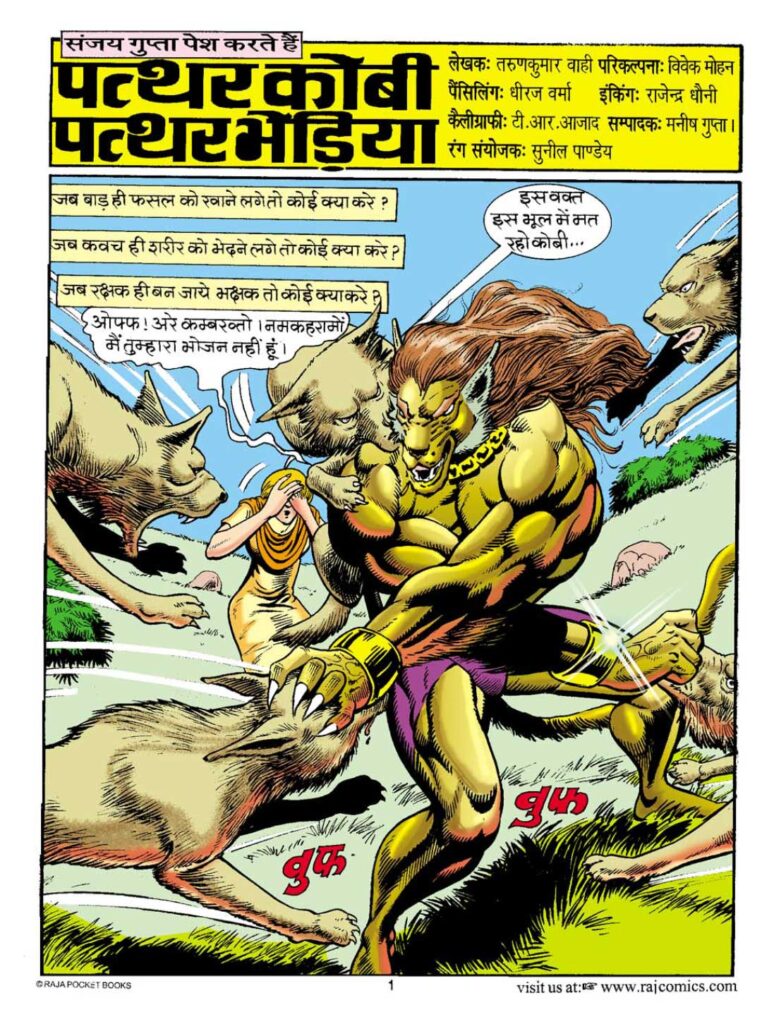
Can a human being’s primitive and violent animal instinct and his just human thinking remain tied to the same thread even when completely separated from each other? What happens when a fifty-thousand-year-old curse from the past knocks on the door of the present and turns the protector into a lifeless stone statue? In the golden era of the nineties, when Raj Comics was at the pinnacle of storytelling and the mythological imagination of its characters, the pair of writer Tarunkumar Wahi and artist Dheeraj Verma presented a creation in the ‘Bhediya-Kobi’ series in the form of ‘Patthar Kobi Patthar Bhediya’, which was not limited to exciting action alone. The comic touches on a mother’s pain, atonement for unintentional crimes, cosmic acoustics, and the everlasting idea of balance between man and animal, which is rarely seen in Indian fiction.
The Mysterious Science of Cosmic Sound Waves: When Mahamuni Bhangam Uncovered Kobi’s Past
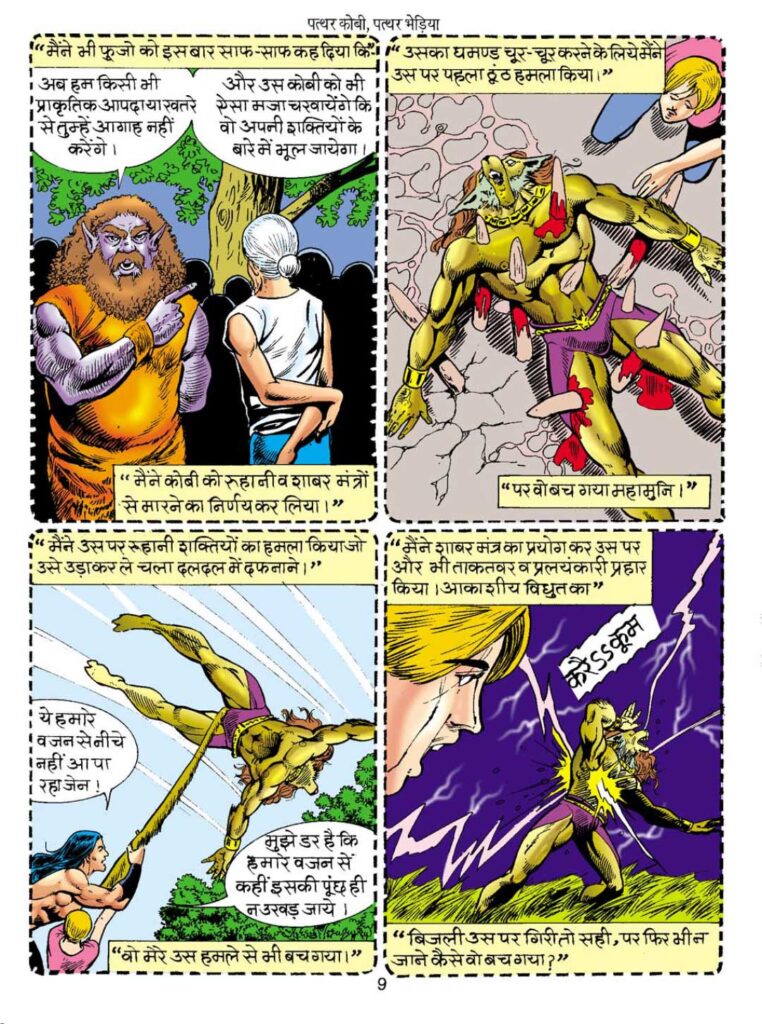
The serious and mysterious foundation of the story is formed when the defeated and disappointed tantrik ‘Karnadhari Sansi’ takes refuge with his guru, Mahamuni Bhangam. Here, the author has beautifully added to the story the theory of ancient Indian thought and modern physics, according to which every sound that comes out of the mouth is never destroyed but keeps resonating in the universe for millions of years. Mahamuni Bhangam’s descent into the world of cosmic sound waves (Cosmic Vibrations) and his discovery of Kobi’s fifty-thousand-year-old past is the most magical and mind-bending part of this comic. This idea corresponds to Hollywood’s concept of ‘celestial records’, but the mythological and tantric atmosphere in which it is presented demonstrates the author’s unique and deeper imagination.
Survya’s Motherhood and Self-Sacrifice: Emotional Layers of a Mythical Tragedy
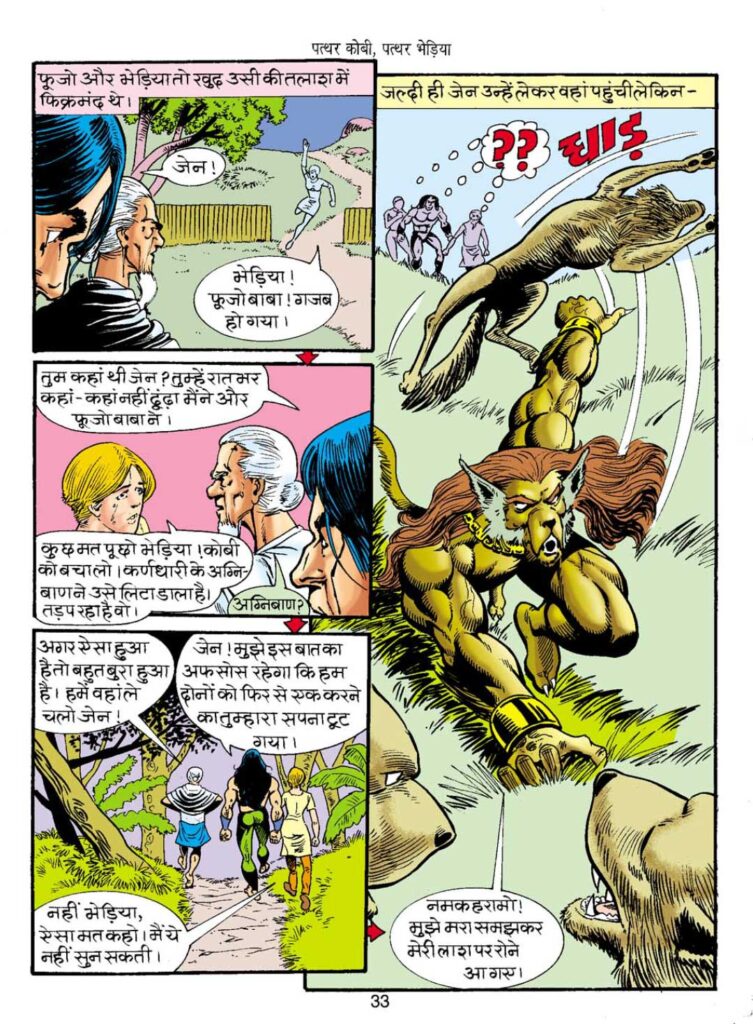
Peeping into the pages of the past, the emotions of the comic reach their peak when the story brings out the love, deception, and tragic incident involving Wolfano’s Emperor Wolfa and Konkan’s Princess Survya. Mother Survya’s curse, which turns her own husband and son to stone, and then Kobi’s willing acceptance of the curse to atone for his father’s sins make one feel the human suffering found in Greek tragedies . Survya’s boon that this stone body will come alive again only through the blood of a virgin girl, bound by a mother’s love, not only reveals the secret of Bhediya’s rebirth but also directly connects the present-day character of ‘Jane’ with that fifty-thousand-year-old mythological link.
The Orgy of the Fire Arrow and the Mystery of the Body: The Maze of Lifeblood Hidden in the Navel
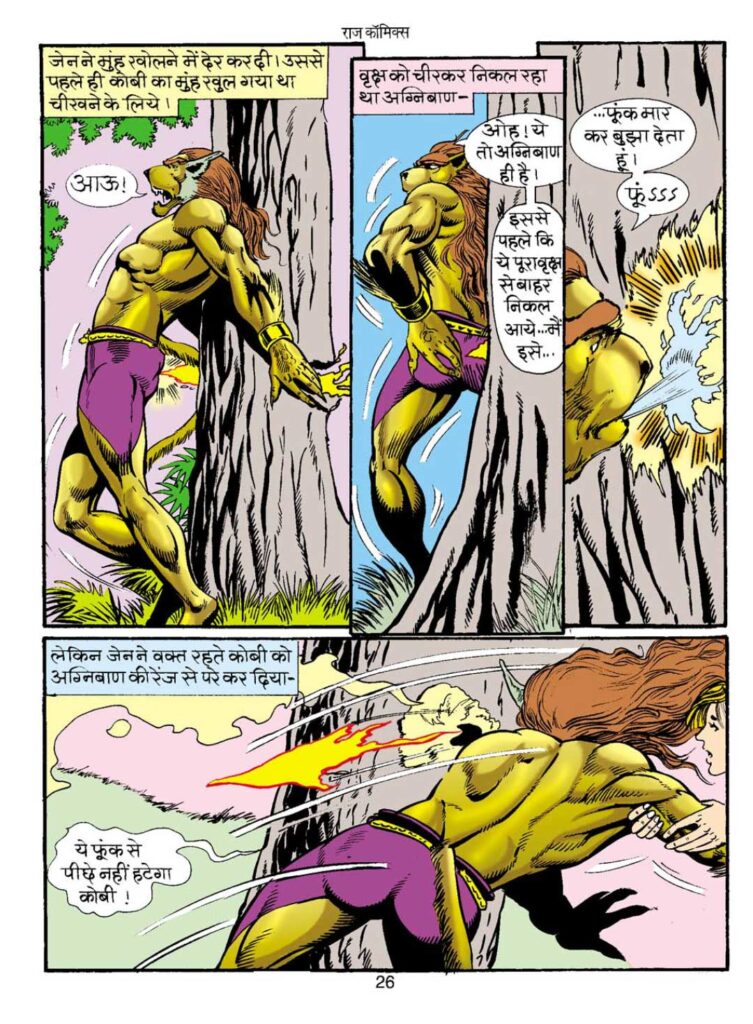
The mystery and thrill of the action in the story reach their peak when the earless Sansi releases a mantra-infused ‘fire arrow’ to dry up the lifeblood present in Kobi’s navel. The reader is shocked when the arrow pierces Kobi’s navel after ripping through forest trees, crocodiles submerged in water, heavy rocks, and even the mace of the wolf god. But this is where the narrator comes up with such an unexpected and profound twist that it makes the story of this comic great—Kobi does not turn to stone because he and Bhediya are two different bodies of the same soul, and that life-giving blood is no longer in the animal Kobi but in the navel of the human ‘Bhediya’. When this mystery comes to light, it becomes clear that even though humans and animals may appear different, the center of their life force is the same.
Protectors Turning to Stone: When Both Bhediya and Kobi Became ‘Stone’
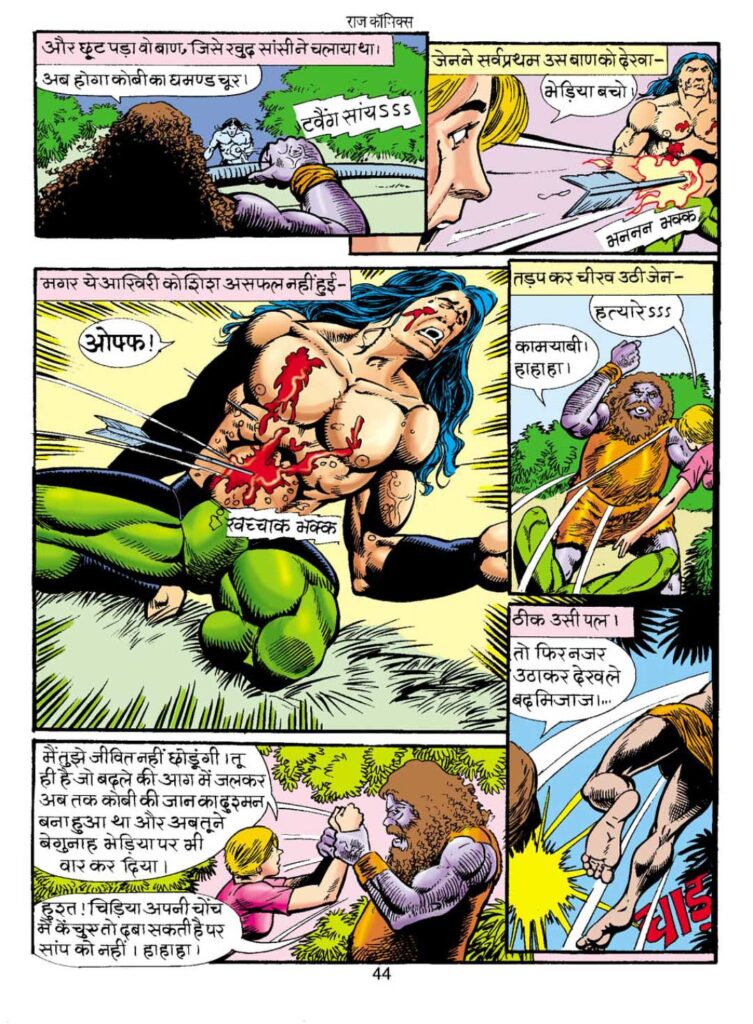
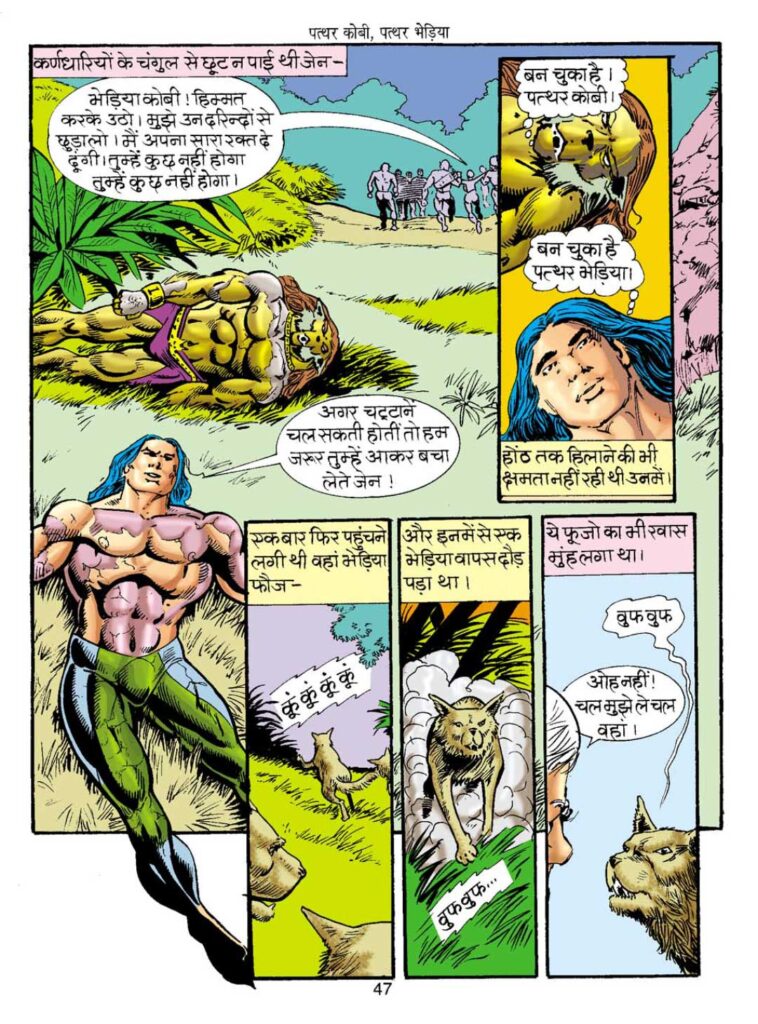
As Sansi’s target shifts to Bhediya, the story is struck by a wave of sacrifice and hair-raising action. Jane’s transformation into a shield against the arrows to save Bhediya and her endurance of wounds on her body ignite the fire sleeping inside him. The blood-soaked form of Bhediya, who pulls the arrows stuck in his chest and buries them in the chests of his enemies, has emerged as extremely terrifying and lifelike through the brushwork of Dheeraj Verma. But Sansi’s fire arrow striking Bhediya’s navel and then turning both of them together into hard and lifeless stone is such a heartbreaking scene that it brings tears to the reader’s eyes. This scene shows how, when the protectors themselves lose consciousness, all of nature and the creatures dependent on it begin to feel orphaned and destitute.
The Snake, the Passerby, and Retributive Justice: A Profound Dialogue Between Jane and Mahamuni Bhangam
The most serious and profound message of this comic comes to light in the scene where the imprisoned Jane, regardless of the danger to her life, reaches the cave of Mahamuni Bhangam and asks him a question related to justice. Jane asks, ‘If a person’s foot falls on a snake while walking along a path and the snake tries to bite that person, who is really to blame?’ This is a wonderful example of the Indian principles of justice and karma. Mahamuni Bhangam’s answer—that ‘an animal does not have the intelligence to think; therefore, it attacks in its own defense. But if a human being, despite being intelligent, becomes blinded by revenge, then the human being is the real culprit’—not only opens Karnadhari Sansi’s eyes but also forces the reader to look within. This dialogue takes this comic out of the world of simple action and turns it into a high-level literary discussion.
Cyclone Cataclysm and the Protective Wall of the Tail: Humanity’s Victory Over the Fire of Revenge
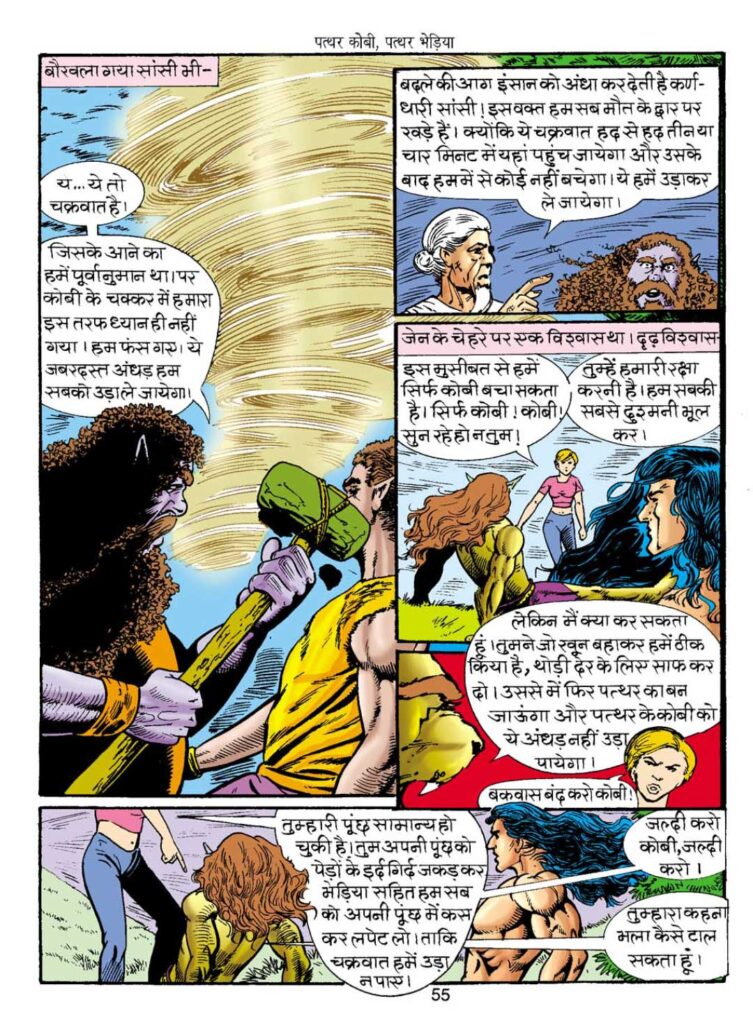
The final scene of the story paints a grand picture of nature’s terrifying form and life returning once again. On one side, Jane brings both stone statues back to life by dripping drops of blood from her severed fingers, while on the other, the sudden onset of a severe cyclone (tornado) wreaks havoc among the Sansis who came to break them with axes, creating a spectacular cinematic effect. When everything is about to be swept away by the devastating storm, Kobi, as soon as he comes alive, turns his enormous tail into a protective wall and saves the same earless Sansi and his tribe by tying them to trees, marking the greatest victory of forgiveness over hatred. The same Kobi who had been roaring at them only moments earlier saves the lives of his own killers with his quiet and innocent kindness, proving that animals may appear cruel, but they do not possess the cunning and animosity of humans.
Dheeraj Verma’s Stunning Illustrations and Final Review: An Unmatched Classic of Indian Comics
From an artistic point of view, artist Dheeraj Verma has produced the finest work of his life in this special issue. The tension in Kobi’s transformed muscles, the pain visible on Bhediya’s face, the dust swirling within the cyclone, and, above all, the visual effect of powerful bodies turning into cracked stone—his panels are magnificent works of art. Rajendra Dhoni’s inking and Sunil Pandey’s colors have filled these scenes with a mysterious and ancient glow. ‘Patthar Kobi Patthar Bhediya’ is not just a comic but an unforgettable document of human emotions, a mother’s curse, atonement, and coexistence with nature, which will continue to remind future generations of comic lovers how Indian comics in the ’90s were at their pinnacle in terms of ideas and art.
